
SLR Responds to Treasury Consultation: Making climate reporting more efficient
by Sophia Davison, Henry Partridge
View post

We elect individuals to represent us, usually via a geographical constituency – a town or a district. These representatives speak for us in parliament and ensure our voices are heard.
But that is only part of the picture. We have other identities beyond that geography; we are parents, employees or hobbyists. We are part of affinity groups who campaign for our rights based on a wide range of characteristics and beliefs. Companies, charities, campaign groups, trusts and educational establishments all speak for us in the public sphere. A modern democracy blends all these voices. Good governments consult widely, including those with a particular position to promote.
Transparency International defines lobbying as “any activity carried out to influence a government or institution’s policies and decisions in favour of a specific cause or outcome”. Companies lobby. But so do charities, campaigners and even individuals. Lobbying has become an important part of the legislative process. Simply put, hearing from those affected could lead to better legislation.
But there are obvious hazards. We must ensure that influence is transparent and that it doesn’t subvert the core democratic process. As Transparency International says, “even when allowed by law, these acts can become distortive if disproportionate levels of influence exist – by companies, associations, organisations, and individuals”. [1]
Some distinguish between lobbying and advocacy, arguing that lobbying is intended to change specific legislation, whereas advocacy focuses on increasing the prominence of an issue. Reflecting this, we might cynically suggest that Non-Governmental Organisations (NGOs) conduct advocacy, whereas companies lobby. It follows that lobbying is “bad” and advocacy is “good”. However, the Organisation for Economic Cooperation and Development (OECD) argues that “attempts to distinguish ‘good’ from ‘bad’ lobbying are fraught with normative judgment”, instead proposing that a distinction based on the “process of lobbying”, rather than the subject, is more helpful in guiding responsible lobbying behaviour. [2]
So, can lobbying be done responsibly? Yes! It is a widespread and legitimate part of the political process. Responsible lobbying can lead to better legislation, rules and standards; increase stakeholder engagement in public life; and serve the public interest. It provides policymakers with invaluable input from the real economy and groups representing societal interests, helping to shape more effective policies. We further argue that lobbying is a sustainability issue for companies and other organisations, because – if done irresponsibly – it poses risks to a company’s social license to operate.
The history books are filled with examples of companies that faced a reputational scandal due to their lobbying practices, which have followed them for many decades. One example is the oil and gas industry’s lobbying against climate science and policy. The reputational risks are compounded in today’s digital age, where anyone with an internet connection can highlight perceived irresponsible practices through social media and other platforms. Working with a group of stakeholders, we followed the OECD’s invitation to look not at cause, but at the process of responsible lobbying.
We produced the Responsible Lobbying Framework (RLF) in 2019 with support from the Meridian Institute. It establishes the principles and practical steps that organisations – companies, NGOs and others – should take to ensure their lobbying is transparent, accountable, consistent, and legitimate. It is based on public sources from Foundations, NGOs, United Nations (UN) bodies, the OECD, and academia.
The RLF was developed by a multistakeholder working group consisting of NGOs and companies. This group agreed that the framework was widely applicable beyond the specific process it was developed for, and should therefore be published, free to use. The RLF codifies a responsible lobbying process through five principles. They are:
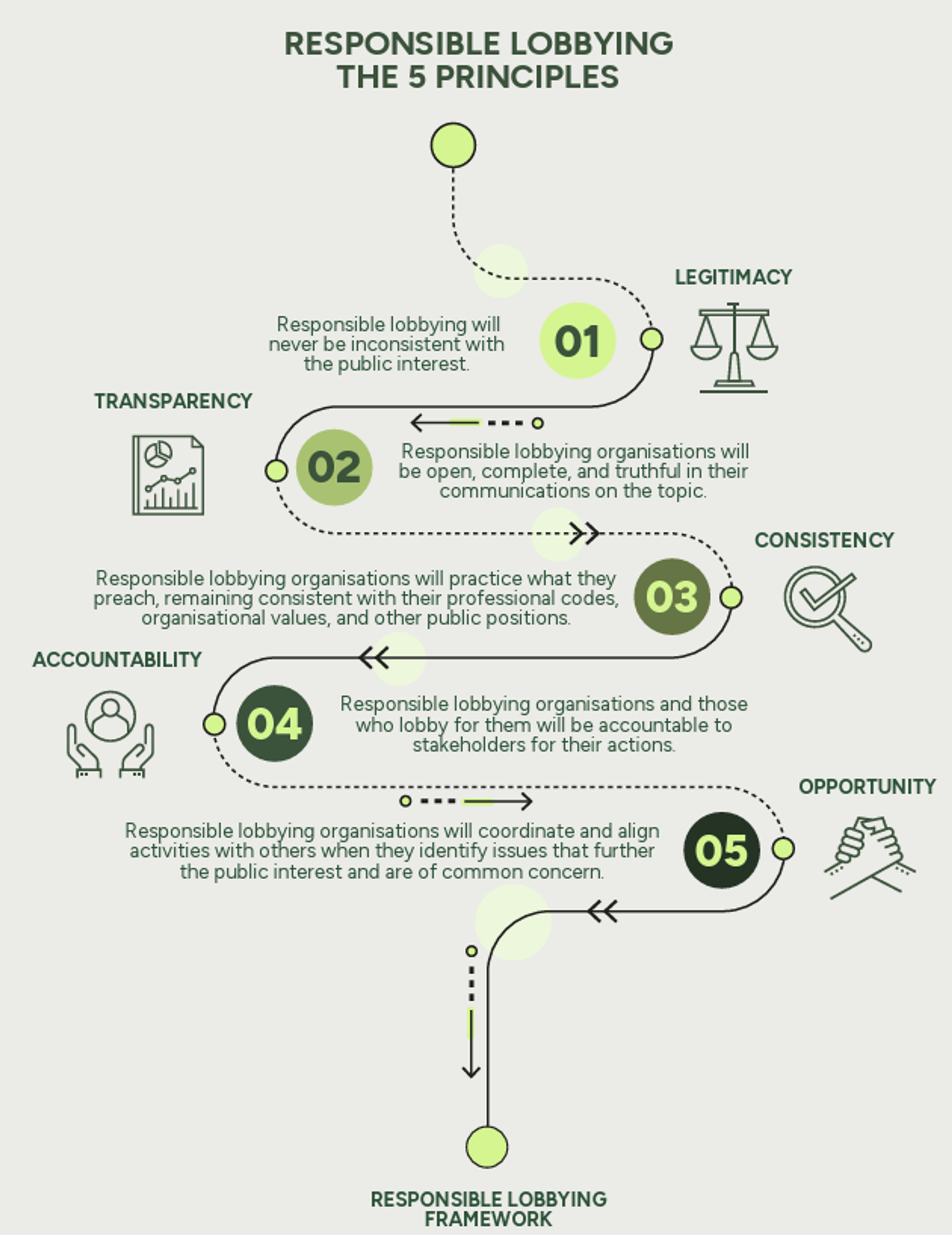
The RLF goes into more detail on what each principle means and provides guidance for disclosures under Principle 2 (Transparency). While the framework is sector-agnostic, it suggests that users may wish to define the key issues of public interest (Principle 1.1), the key public policy frameworks (Principle 1.3), and the expected arrangements for managing conflicts of interest and preventing damage to organisations and the public interest (Principle 1.5).
The RLF’s rigour has been validated externally. The Good Lobby Project, which provides the world’s only systematic assessment of corporate political responsibility assessment and reporting initiatives, ranked it as the strongest standard or initiative – out of 27 initiatives assessed – in its most recent ranking (2025). The Framework’s coverage of lobbying and advocacy activities, influence via third-parties, and governance were noted as strengths. [3]
The transition toward responsible lobbying is no longer just an academic debate - it is gradually reshaping capital markets, sector benchmarks, and regulatory expectations. Pressure from investors has forced energy companies to publish corporate climate lobbying reports, which subject their trade association memberships to unprecedented public scrutiny.
In 2021, a group of investor networks, asset owners and asset managers launched the Global Standard on Responsible Climate Lobbying. [4] In 2022, the United Nations Principles for Responsible Investment (PRI) set out its view on the investor case for responsible corporate political engagement. It argued that unchecked lobbying can raise governance risks; weak regulatory frameworks can exacerbate regulatory and reputational risks for companies; and irresponsible lobbying could impede global sustainability objectives and contribute to system-level risks, such as climate change. [5]
Voluntary campaigns and initiatives have also started considering responsible lobbying; in 2022, the UN Race to Zero campaign updated its criteria, introducing a “starting line” entry requirement for members to prove that their lobbying activities are aligned with net zero. [6] Investor pressure has not limited itself to the oil and gas industry or climate lobbying. For example, members of the Interfaith Center on Corporate Responsibility and 20 investors representing nearly $140 billion of Assets Under Management (AUM) signed an open letter to food and beverage industry executives, requesting them to step up their lobbying disclosures. [7]
The RLF has been integrated into sector benchmarks and used by NGOs to assess companies’ lobbying practices. The Access to Nutrition Initiative (ATNI)’s Spotlight on Lobbying reports, which benchmark the world’s largest food and beverage manufacturers against the RLF, are a prime example. [8]
While the assessments highlighted significant gaps in corporate transparency, they also established a baseline, encouraging industry peers to adopt the management systems of frontrunners.
Additionally, voluntary transparency is being transformed into a mandatory compliance exercise - under the EU Corporate Sustainability Reporting Directive (CSRD), companies that identify “corruption and bribery” or “political engagement” as material topics are required to report in line with ESRS G1 (Business Conduct). This includes disclosing their lobbying activities (types and purposes) and political contributions (financial or in-kind).
The Framework was consciously developed as a best practice framework, and we expect full compliance to take multiple years to achieve for any organisation starting from scratch. That should not, however, deter organisations from starting and then building maturity over time. We recommend four practical steps to get started:
Acting today to increase the responsibility of your organisation’s lobbying preserves your social license to operate, builds compliance with upcoming regulations, and will help you engage more consistently and effectively, leading to better outcomes both for your organisation and wider society.
Enjoyed this article? For more like it, get SLR's quarterly sustainable business briefing straight to your inbox.
Sign Up
by Sophia Davison, Henry Partridge