SLR Responds to Treasury Consultation: Making climate reporting more efficient
by Sophia Davison, Henry Partridge
View post

While data centres aren’t a new concept in Australia, their scale and rate of growth in recent years have created adverse local development pressures and unsustainable social tensions within the communities they surround. This has been particularly evident in metropolitan Sydney and Melbourne, as these regions typically coincide with project sites with the largest available data bandwidth and highest local population density.
The community backlash brewing this year has culminated in the Australian Government stepping in and recognising the issue is one of national interest. In response, development of a Commonwealth AI policy is now under way.
The resolutions agreed at the recent National Cabinet meeting provided a clear path forward:
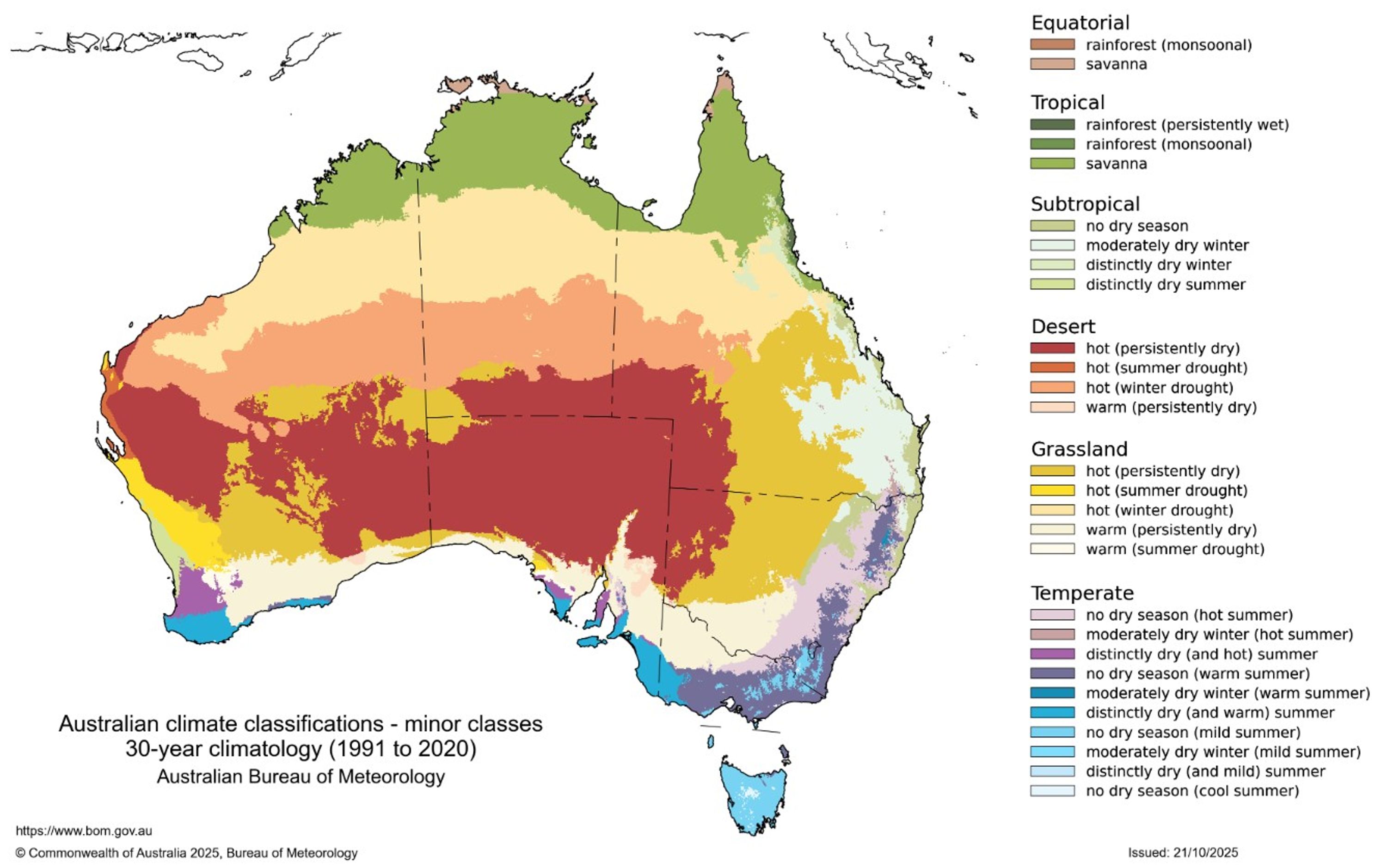
AI compute generates a significant amount of heat, and in an Australian setting where many regions experience hot summers with constraints on available water supplies, the sustainable design of a data centre’s cooling system to manage the transfer of that heat is a critical consideration. It should form a core part of a project’s origination activities undertaken in close coordination with land use compatibility planning and siting analysis to identify environmental, social and infrastructure fatal flaws.
Sustainable cooling system design for a data centre project also means achieving the energy trilemma by balancing environmental and social responsibility with secure, reliable operations and affordable, accessible energy.
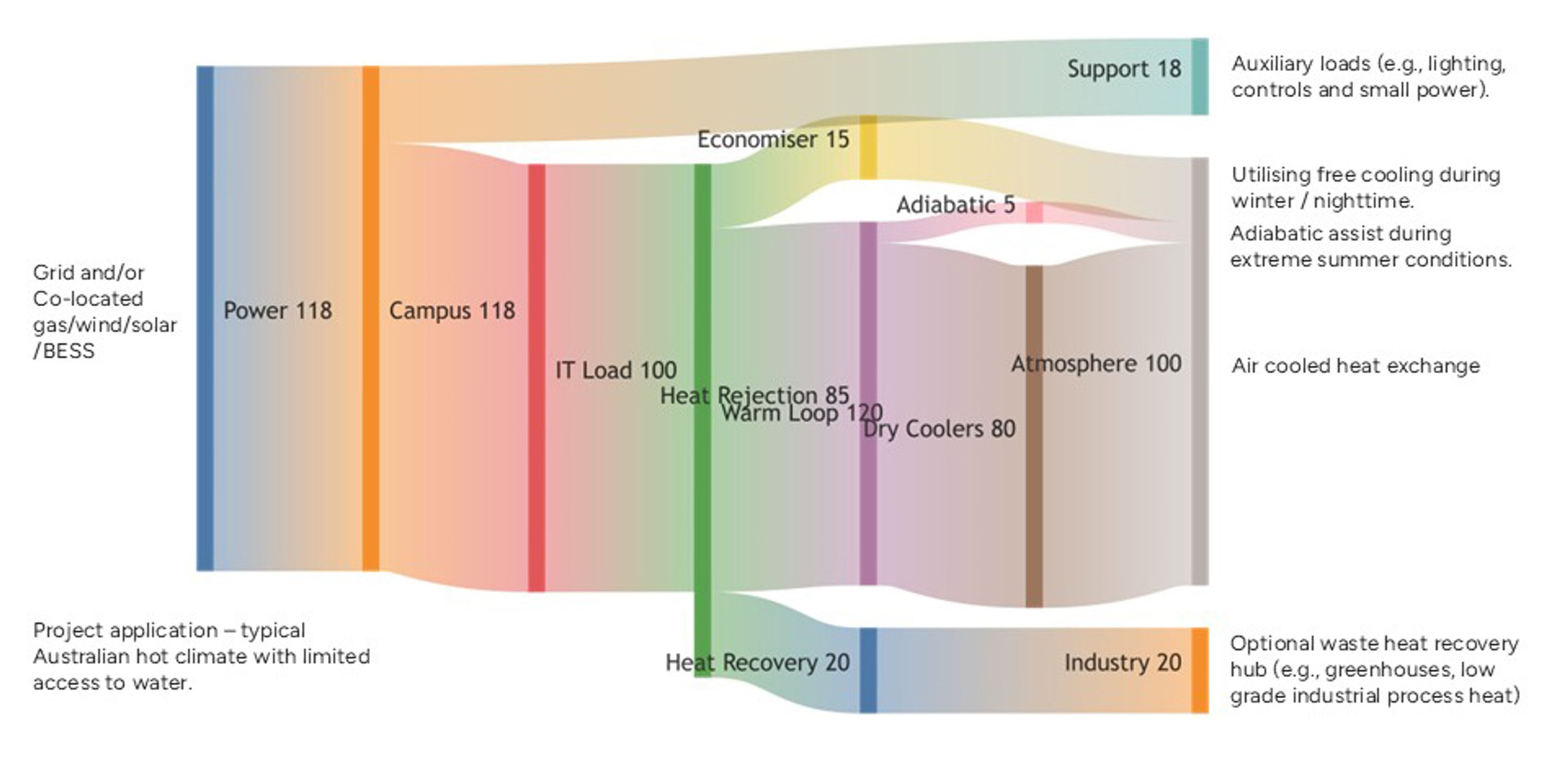
For AI and high-density compute workloads, liquid cooling technologies are increasingly outperforming conventional indoor air cooling in both energy efficiency and rack density capability. Industry is trending towards direct-to-chip and immersion cooling as the dominant technologies for integration within the AI infrastructure itself. For data centres in Australia, where robust planning, environmental and social regulatory frameworks are in place and energy prices are front of mind, the main challenge lies in pairing these technologies with the right exterior cooling system components, so that heat rejection to outside atmosphere is energy efficient, cost effective and environmentally sustainable.
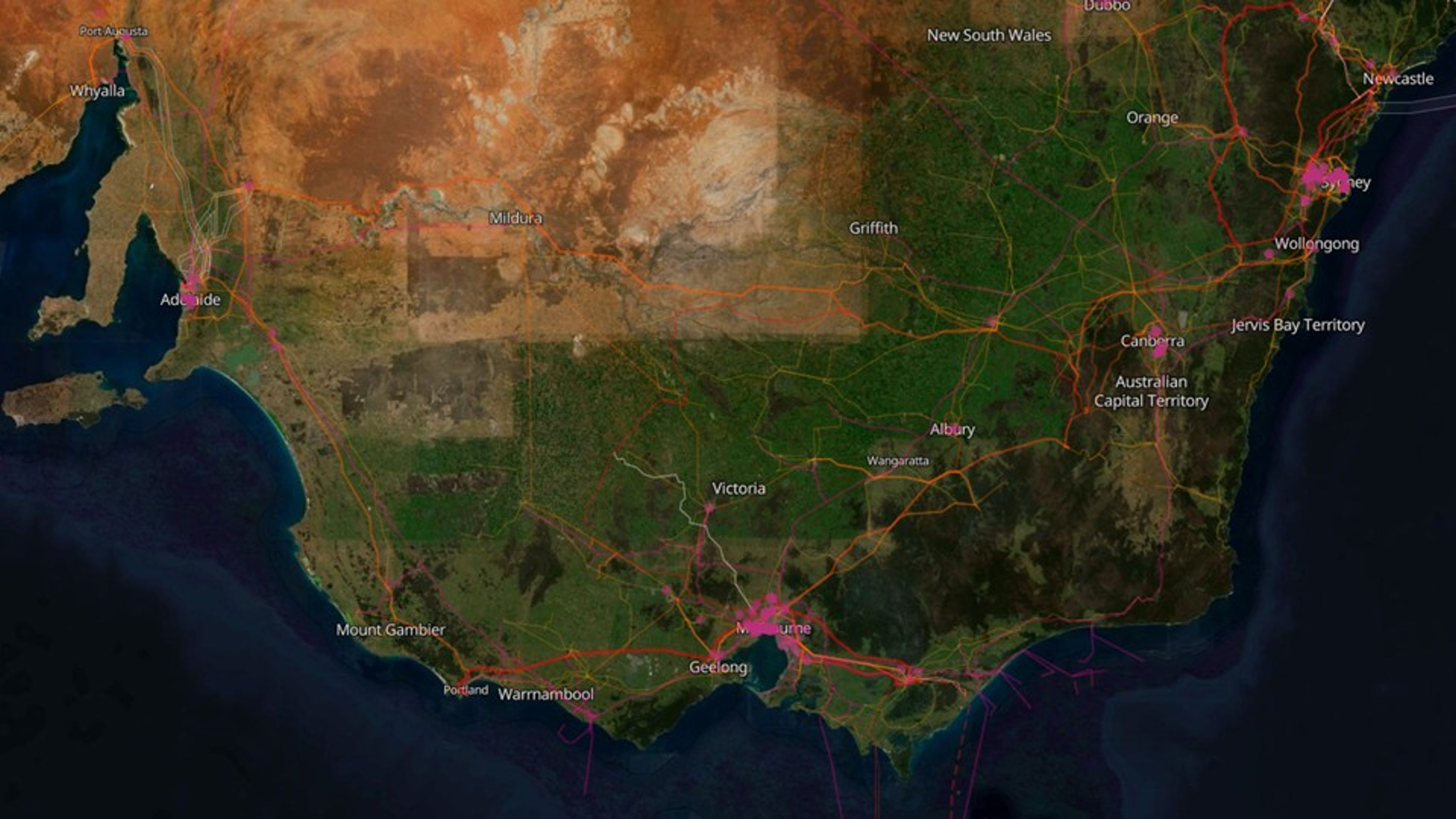
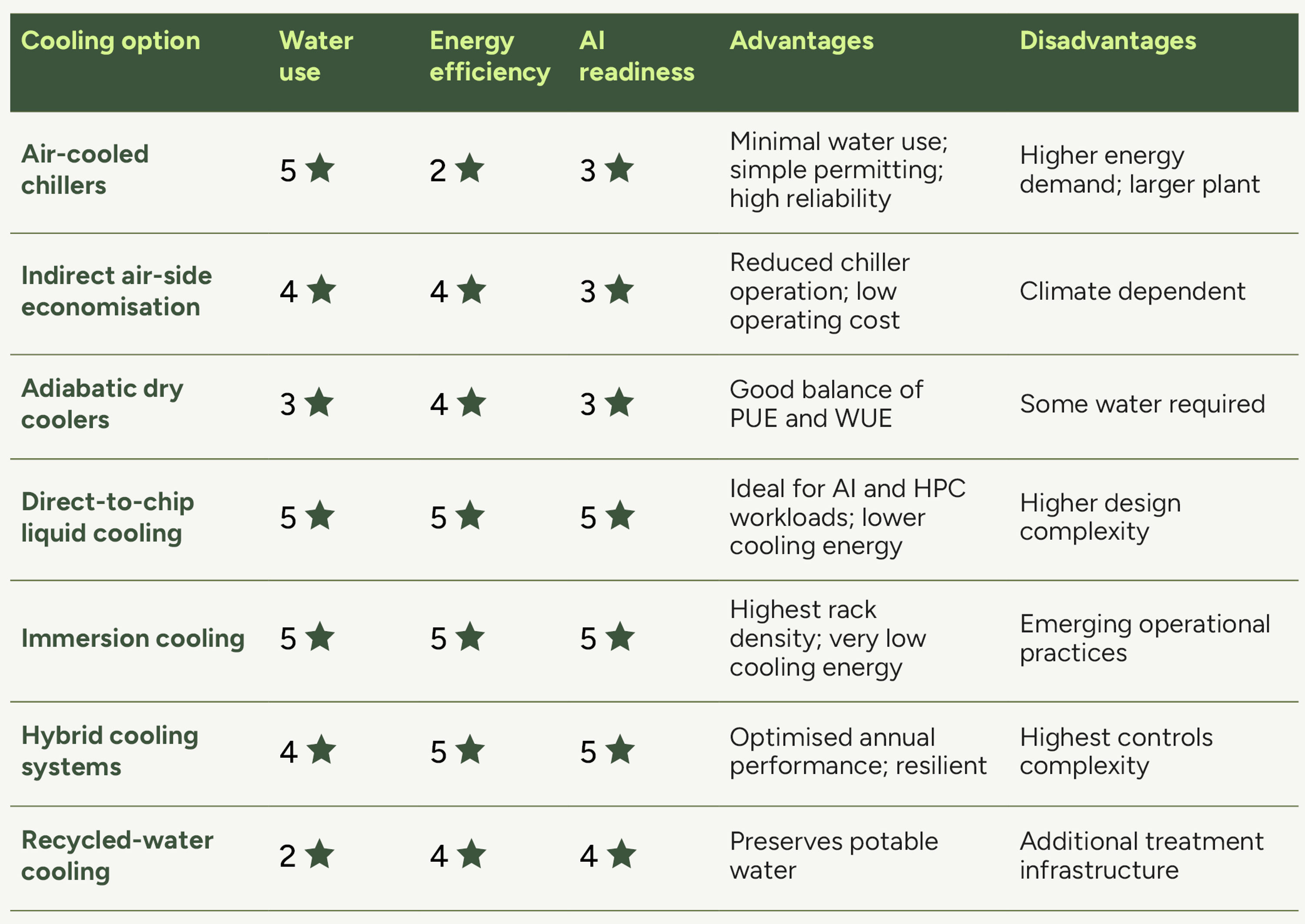
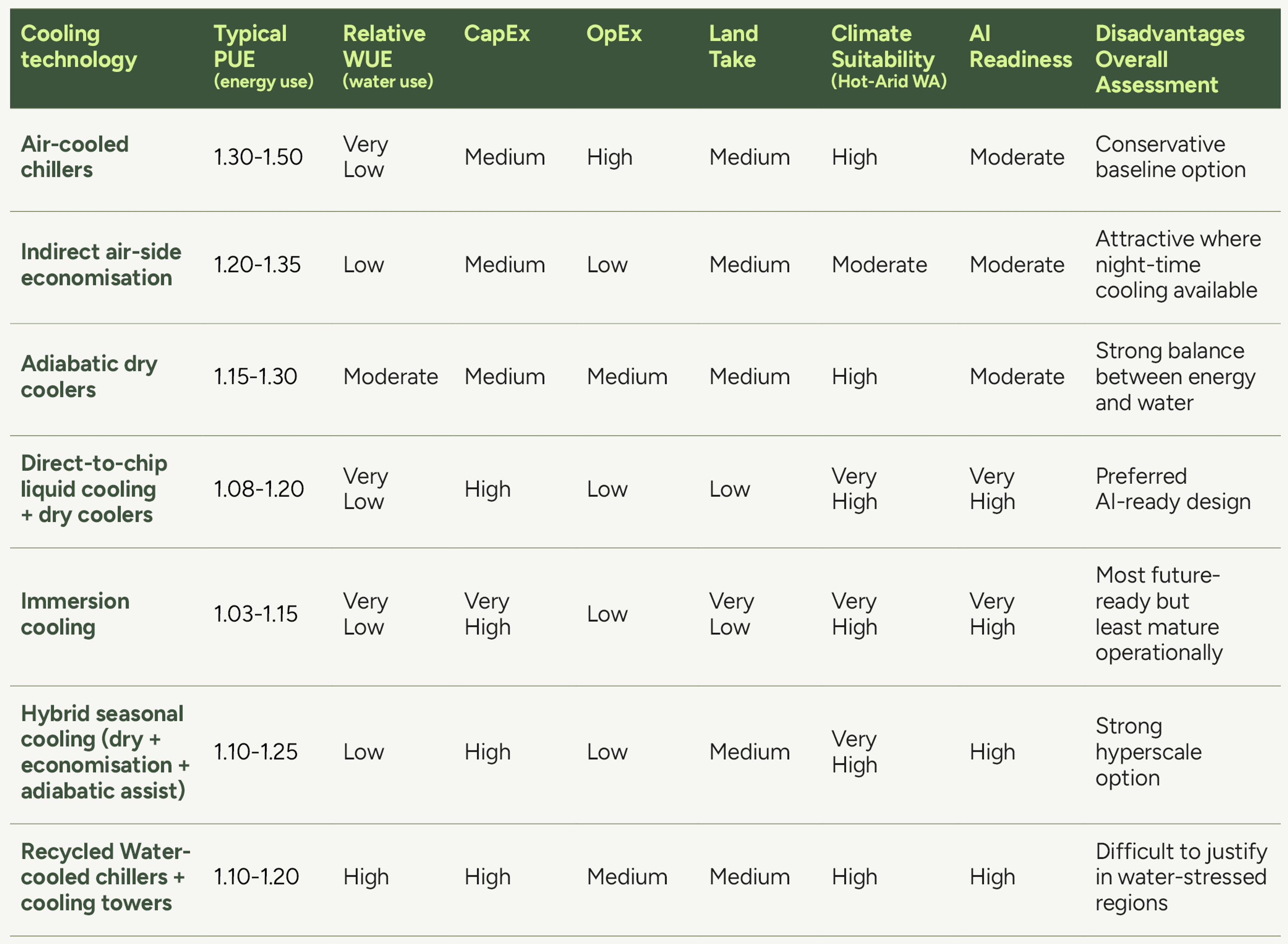
For grid-connected developments, taking an example 100 MW compute load in a hot, dry and water-constrained location like the Mid West region of Western Australia, the lowest project delivery risk solution is likely to be air-cooled chillers combined with indirect air side economisation. Using this design concept, 95% of annual cooling duty could be delivered through direct to chip liquid cooling, dry coolers, and economisation, with water only consumed occasionally during extreme ambient conditions via adiabatic assist. It also involves minimal water approvals complexity and a familiar supply chain, but that comes with high long term energy consumption. Refer Tables 1 & 2 for a qualitative assessment of the options reviewed. This may be the optimal system configuration for a project location that experiences dry summers and access to high capacity factor renewable energy plus firming gas generation. The configuration may be different for a location where high humidity in summer or sub-zero conditions are key considerations.
For larger projects that incorporate co-located energy precincts within the same project development area, power generation systems may provide a valuable source of cooling for data centre operations. One example is the recovery of waste heat from gas fired generation through absorption chillers in the exhaust gas path. Modern, commercially available systems use a closed loop distilled water cycle as the refrigerant and lithium bromide as the absorbent. A similar concept may also be possible using solar thermal or geothermal plant as the energy generator.
When minimising water usage is the overarching goal, then applying a design hierarchy of:
But the main point is, selecting the right type of cooling system for the right location is critical to achieving sustainable outcomes for data centre projects and the local communities that surround them.
Many developers are investigating opportunities to expand within existing footprints, upgrade legacy infrastructure, and respond to rising energy, emissions, climate and nature-related pressures. Design of cooling systems within data centres is a critical part of the project origination process to identify fatal flaws early. SLR provides end-to-end advisory services across the data centre lifecycle, supporting clients through planning, design, delivery and ongoing operational performance, as well as retrofit and optimisation advisory, compliance management and ESG performance improvement. Our multidisciplinary team works with hyperscale developers from the earliest stages of a project, providing support across site selection, feasibility, planning and approvals, regulatory and social licence considerations, and integrated design and delivery.
by Sophia Davison, Henry Partridge