Understanding traffic and transport risks in onshore wind projects
by Charlie Seventekin, Ian Cronshaw
View post
The success of an onshore wind projects is rarely defined by a single issue, but by a complex set of interconnected ‘critical paths’. This includes grid connection and network capacity, planning and environmental approvals, community and stakeholder acceptance, ecology and biodiversity considerations, engineering and constructability constraints, and land access and tenure arrangements.
In this Onshore Wind Critical Path Thought Leadership Series, our technical teams will explore these topics in detail, highlighting challenges and presenting potential solutions.
Articles in the series so far:
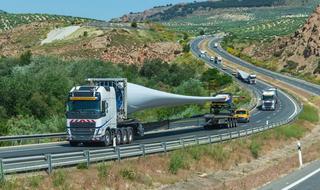
As the global onshore wind pipeline expands, developers are pursuing larger, more powerful turbines to reach the desired energy generation capacity for their sites. For many onshore wind projects, this means one of the defining feasibility factors is turbine selection and whether these turbines can physically reach the site. For example, modern turbine components include blades approaching 100 metres long, tower sections up to 6 metres wide, nacelles close to 100 tonnes, and transformers of around 250 tonnes. These must all be transported through a series of Oversize Overmass (OSOM) / Abnormal Indivisible Load (AIL) movements from a port to a remote ridgeline – often several hundred kilometres inland.
In addition to this, the transportation of turbines is now one of the most heavily scrutinised parts of an onshore wind project’s approvals process. Due to these factors, traffic and transport can no longer simply be seen as a compliance step. It increasingly shapes approval timelines, financing confidence, and constructability and program, therefore embedding itself as a core critical path for onshore wind delivery.
Across the globe, developers are often working within an evolving and inconsistent approvals environment. Expectations around construction traffic management, swept-path and pinch-point analysis and road upgrades have grown significantly,but they vary widely between states / regions, road authorities, and individual local government areas.
The first challenge is sheer scale. Depending on the turbine model and project configuration, a single modern turbine needs roughly a dozen OSOM / AIL deliveries under permit (pilot, escort and / or police), so a utility-scale project means hundreds of deliveries. These are often hauled to remote or elevated locations where existing roads were never designed for movements of this scale. With many projects competing for the same limited corridors, local governments have warned that a single project alone can put well over a thousand oversize movements through their districts.
Against this backdrop, the harder problem is often uncertainty rather than data. Approval pathways and conditions differ markedly between states / regions, road authorities, and individual councils, so what one assessor accepts, another may require to be re-modelled, re-surveyed, or redesigned. Requirements can also be escalated late, resetting months of work. Most significantly, an authority can rule out a preferred haulage route altogether and because the route dictates which councils, intersections, bridges, and upgrades are even relevant, a route change effectively restarts the assessment.
The route itself also rarely works unmodified. Enabling these movements commonly means physical works – widening intersections and pinch-points, strengthening pavements and bridges, making signage removable, trimming vegetation for sight lines, and adding passing bays – each one needing design, consent, and consultation. Some governments are beginning to coordinate this: for example, in New South Wales, Australia, the $128 million Port to REZ program is upgrading 19 locations between the Port of Newcastle and the Central-West Orana zone for exactly this purpose [1]. But turbines keep increasing in size and longer blades and wider towers steadily shrink the number of viable routes. From this, it’s clear that the haulage task is now a core project design input, not a downstream logistics exercise.
Changes in turbine supplier, blade length, tower dimensions, or trailer configuration can materially alter swept paths, clearances, and structural loading, requiring earlier assessments to be repeated and site layouts, access points, and road designs to be revised.
Leading developers are responding by bringing transport advice in at site selection and concept design, rather than retrofitting a route once the layout is locked. Turbine selection, site access, and even project boundaries can then reflect what can actually be delivered.
The toolkit is also expanding: early OSOM / AIL route studies and swept-path assessments to confirm pinch points, bridges, and overhead structures; early engagement with road authorities and councils to build early agreement and confidence around the preferred route and identify enabling works before lodgement; and clear, upfront management of pilot and escort requirements, night-time movements, and workforce transport.
Key considerations for a successful onshore wind development include:
The strongest projects will establish early which turbine configurations, access points, enabling works, and approval pathways provide the greatest delivery certainty. Treating transport as an early development and design input reduces redesign, protects the program and gives investors greater confidence that an approved project can actually be built.
At SLR, we are seeing firsthand how early transport and approvals advice helps developers reduce uncertainty, improve project bankability, and achieve more efficient approval pathways in an increasingly complex regulatory environment.
Contact our Transport teams to see how we can support you with your onshore wind project.
Get in touch