
ISO 14001:2026 and IED 2.0: From environmental compliance to strategic transformation
by Sebastian Katsch, Claire Bushell
View post
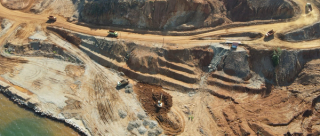
What does it take to support cleaner technology and infrastructure – like electric vehicles, wind turbines and energy storage systems – that shape the path to decarbonisation?
As the global economy strives to secure the energy transition, demand for critical minerals, such as cobalt, nickel, lithium, copper, and rare earth elements, has surged. The rapid expansion in critical mineral extraction, processing and manufacturing has not come without environmental and social trade-offs. And those oversights did not go unnoticed: expectations have been moving upstream, with new due diligence laws making companies legally responsible for human rights and environmental impacts across their value chains.
From legal non-compliance and supply disruption to reputational damage and loss of market access, the risks are diverse, but the message is consistent: inaction erodes resilience.
In this article, we look into carbon-intensive supply chains that produce batteries: how manufacturers and OEMs can lead the charge in reducing emissions, and what can be improved to turn opaque supply chains into traceable networks.
Cross-referencing the UK, EU, US, Australia, and Canada critical minerals lists yields 70 different commodities, with only 35 common across all five.
In general, minerals and metals essential to the energy transition and modern economies, characterised by: high economic importance to key industrial sectors; supply chain vulnerability due to geographic concentration, geopolitical risk, or substitution difficulty; and strategic importance for decarbonisation technologies, renewable energy infrastructure, or advanced manufacturing.
The lists of critical minerals change over time, reflecting the changes to the supply chains along with influence on the economy, and also as methodologies to assess them get updated.
Influences such as geopolitical events have significant impacts on their assessment, such as the conflicts in Ukraine and the Middle East, the COVID-19 pandemic and political regime changes.
Most examples include metals such as copper, aluminium, lithium and nickel – along with minerals such as graphite – as key enablers of energy transition technology. Other examples include tungsten, which is a strategically important metal for the defence sector.
Batteries have become a critical part of the global energy transition. They play a central role in electrifying mobility and enabling a higher share of renewables within the power mix. The demand for batteries will significantly increase during the coming years. For instance, the battery production supporting electric vehicle manufacturing is expected to triple from 1 TWh in 2024 to 3TWh in 2030 [1].
Within the automotive sector alone, the embedded greenhouse-gas emissions of batteries in electric vehicle production can account for ~20-40% of total emissions [2], underpinned by a sharp increase in the regulatory, investor and OEM pressure, as proves the latest EU Battery Regulation [3] and third-party scrutiny from the Corporate Climate Responsibility Monitor 2025 [4].
Our research has shown that 55 to 85% of a battery’s cradle to gate emissions originate from upstream in material extraction, refinement and processing. The values can vary substantially between different battery producers based on their suppliers’ practices, energy mix, processing technology and regional context.
Our client, CATL, the world’s leading Chinese battery manufacturer, highlights in its 2023 Carbon Accounting Report [5] that 86% of its total emissions (Scope 1 + 2 + 3) relates to Category 1 “Purchased Goods and Services”.
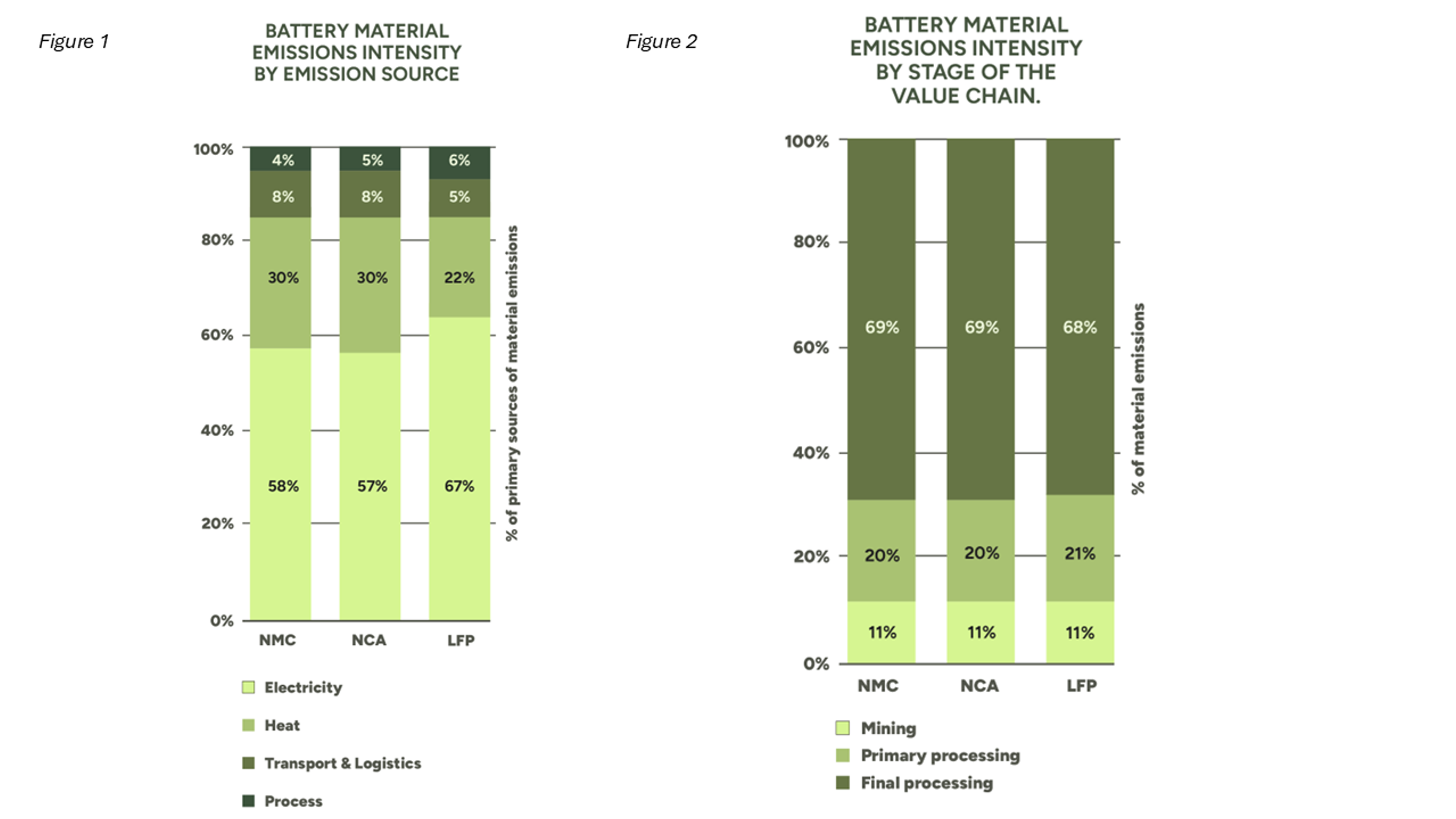
Analysing the material emissions for Lithium Iron Phosphate (LFP), Nickel Cobalt Aluminium (NCA) and Nickel Manganese Cobalt (NMC) battery chemistries, we concluded that graphite, aluminium, copper and nickel combined cover more than 80% of embodied emissions in each battery chemistry [6]. Going further, figure 1 below shows that emissions arise during energy intensive final processing stages, driven by electricity and heat use. In fact, electricity consumption accounts for roughly 60% of material-related emissions, making renewable energy adoption the single most impactful lever.
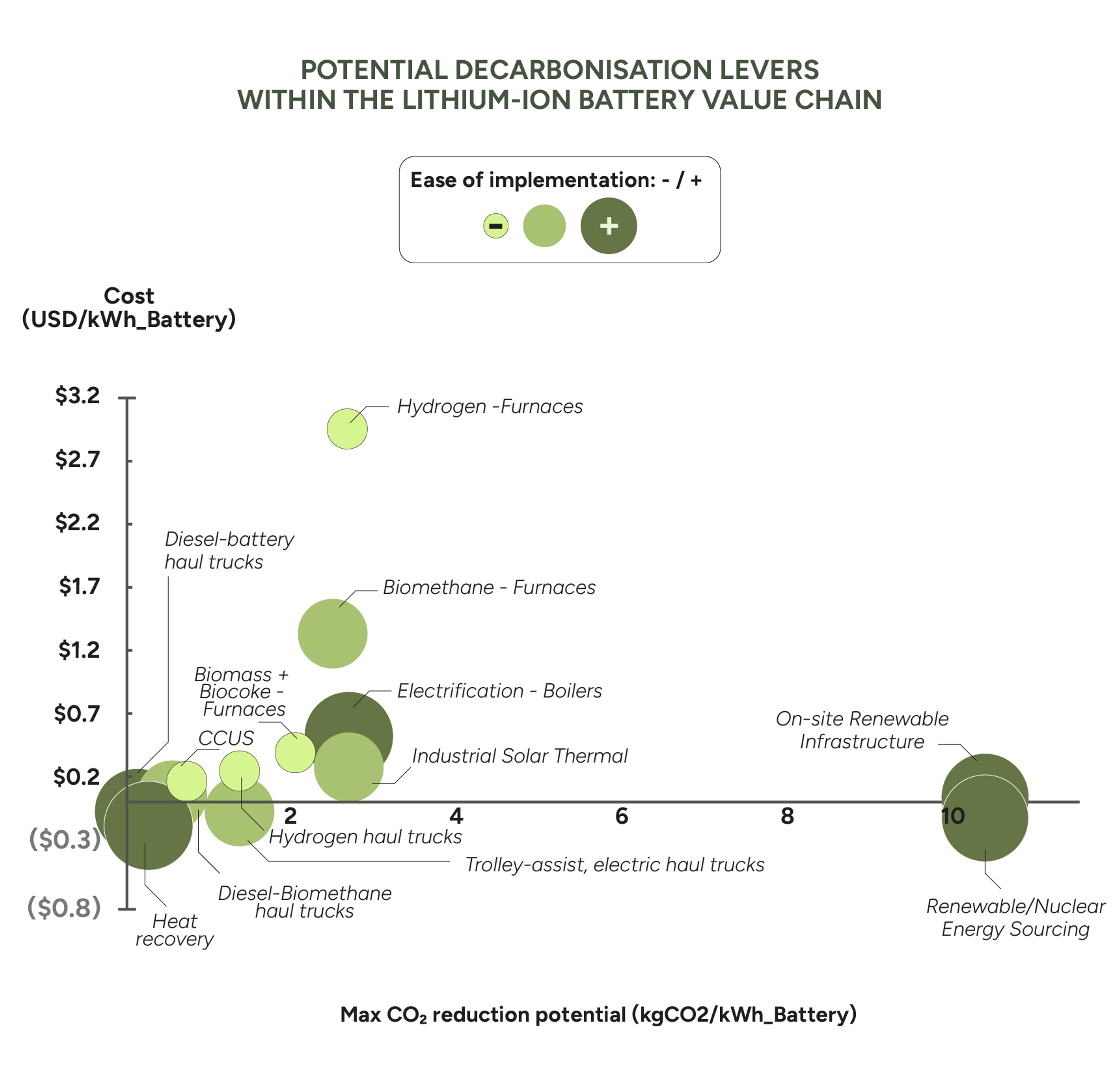
Knowing that competitive differentiation of battery manufacturers will emerge through low carbon materials (topped with greater supply chain transparency, which we’ll broach on later in this article), which decarbonisation levers will most effectively reduce emissions?
Our team has benchmarked the available solutions against their costs and ease of implementation, and has highlighted that the most immediate step is the decarbonisation of electricity used throughout the battery supply chain.
Transitioning minerals processes to renewable power through corporate power purchase agreements (PPAs), energy attribute certificates (EACs), and on-site generation offers a cost-competitive, proven and rapidly deployable pathway. A detailed analysis and dedicated next steps can be found in our guidebook, Battery emissions report available on slrconsulting.com [6]. And if you’d like to explore what this means for your specific operations or investment strategy, reach out to us, and we will walk you through it.
1. Build a granular emissions map
2. Engage suppliers to understand barriers and risks
3. Collaborate to unlock action
Transitioning to responsible, low carbon battery materials is both urgent and achievable. Decarbonising battery supply chains is no longer a technical option, it is a strategic imperative for the future of mobility and clean energy.
To summarise, companies who act early will:
Beyond emissions reductions, companies must also consider the political and financial conditions shaping mineral availability. From car manufacturers and governments to individual consumers asking where their minerals come from, sustainable & responsible sourcing is not just compliance, it’s about creating value for citizens, mining professionals, communities, and future generations.
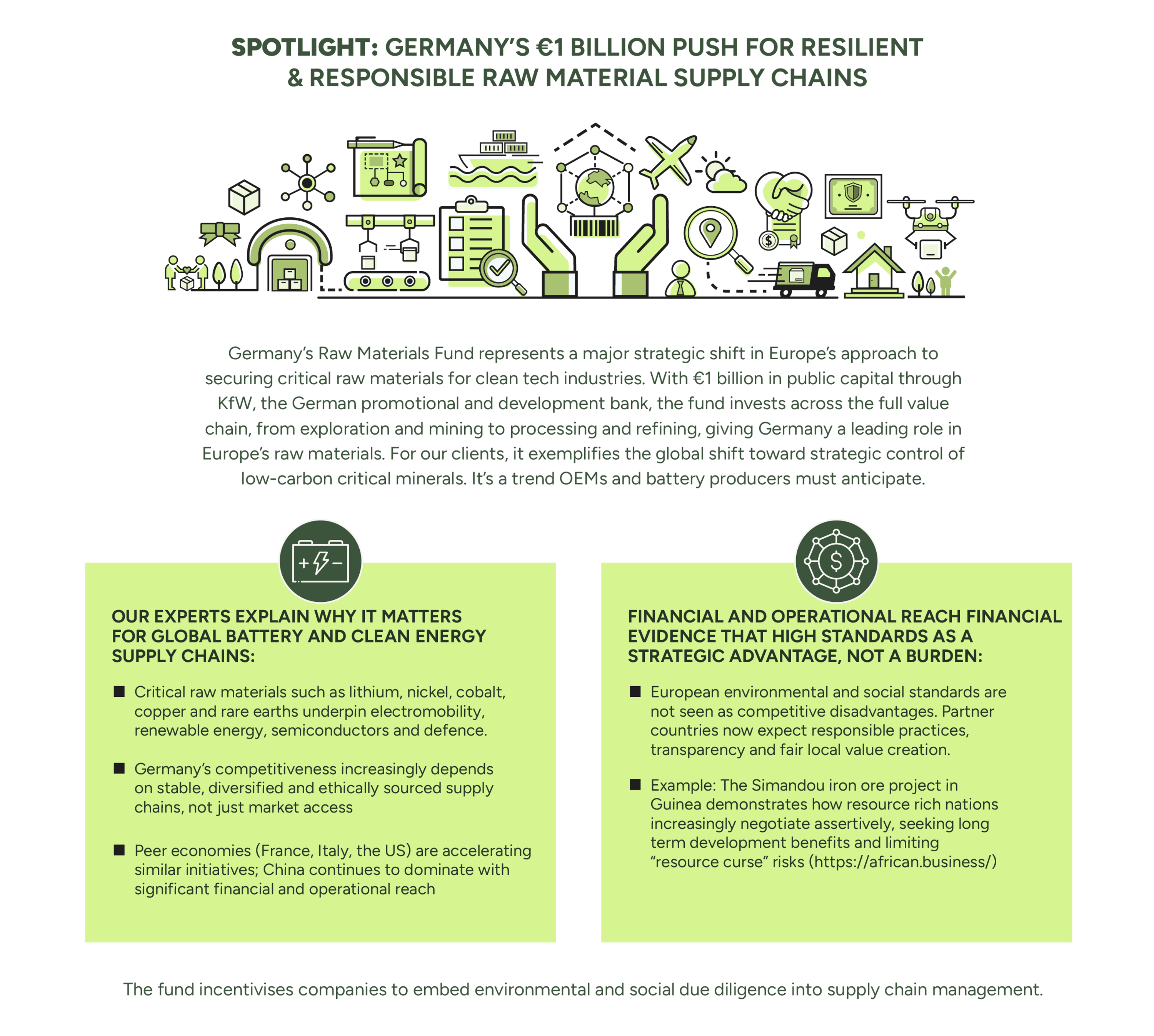
The policies we mentioned earlier, topped by others such as US Dodd Frank Act Section 1502, OECD Due Diligence Guidance for Responsible Mineral Supply Chains, EU Conflict Minerals Regulation [7] also demand transparency and accountability across entire supply chains, particularly those linked to conflict-affected and high-risk areas where much of our critical minerals are found.
Africa, which holds around 40% of the world’s critical mineral reserves sits at the heart of this transformation. Yet, investment and sourcing are often accompanied by environmental damage, community exclusion, and poor working conditions. In 2024, the SLR Better Mining group, whose goal is to transform mining operations of artisanal and small-scale mining (ASM) into safer, more transparent, and economically empowering ventures, launched TRACE 2.0, a 12-month, externally funded project to strengthen the minerals traceability platform. The goal was simple: make the platform more reliable, more scalable, and easier to use for both field teams and clients [8].
The project delivered upgrades to the core architecture, tighter access controls, and new features that improve data quality, transparency, and usability. These shortened issue resolution cycles and improved shipment-level assurance, with fewer data entry errors and faster ticket closure. In the past year, experts and miners showed what steady, practical action can deliver on the ground.
In the DRC and Rwanda’s 3T (tin, tungsten, tantalum) sector, corrective action implementation rose significantly, proving that when mines identify risks and follow through, site conditions improve.
And in Madagascar, the team began building a responsible mica supply chain – supporting exporters, embedding due diligence, and showing that artisanal miners can participate in global markets when conditions are safe and fair.
If you are part of these supply chains – as a buyer, financier, policymaker, or partner – engage directly with ASM rather than step away from it. Support monitoring, training, and traceability. Help build finance that rewards safe and responsible practices. And focus on the basics: fewer incidents, safer pits, and more stable livelihoods. At SLR Better Mining, we will keep bringing evidence and solutions from the ground – but we can’t do it alone. You are invited to stand with us, share your ideas, and help make change last.
Enjoyed this article? For more like it, get SLR's quarterly sustainable business briefing straight to your inbox.
Sign up
by Sebastian Katsch, Claire Bushell

by Simon Hodgson, Daniel Witte, Blake Zheng

by Ashley Gibson