
Reducing Scope 3 emissions: A practical framework for action
by Henry Partridge, James Balik-Meacher, Miguel Oyarbide
View post
For most organisations scope 3 is where they can have the greatest impact towards reducing emissions, but typically, this is the area in which they have the least clarity on how to act.
Scope 3 emissions ordinariliy account for approximately 70% or more of an organisation’s total emissions, and these sit across multiple suppliers, products and customers, rather than inside the four walls of the business.
That makes scope 3 a difficult number to get a grip on. A single target sitting in a disclosure document does not tell anyone what to do on Monday morning, and treating the whole of scope 3 as one undifferentiated reduction effort tends to produce one of two failure modes;
This led us to develop our Scope 3 Reduction Framework, which offers a credible and practical way to reduce emissions by distinguishing between the reductions organisations can control or influence, and those that require customer action, external market change, or broader industry transformation.
The way through is to stop treating scope 3 reduction as one bloc. By breaking down our framework to each category and sequencing action on how much control an organisation actually has, rather than which number looks best in a slide, a target becomes a credible plan.
Some of the reductions in any emissions projection happen regardless of what an organisation does.
Grid decarbonisation already baked into existing policy and market trajectories lowers the embodied emissions in everything a business buys, without a single internal decision being made.
This is real and worth naming, because it changes the baseline an organisation is working from. It is also equally important to be honest about what it represents. For example, a tailwind is an assumption about the world, not a decision a business takes.A target built mainly on tailwinds is a bet on policy, not a plan.
Everything an organisation can change unilaterally sits here, from lower-carbon materials and suppliers to redesigning products and services, improving circularity, and increasing energy efficiency.
It is also where SBTi's newly finalised Corporate Net-Zero Standard continues to prioritise direct, source-level reduction ahead of other routes. Carbon credits and certificates can complement a strategy under the updated standard, but they do not substitute for reducing at the source. That makes technical solutions the lever to explore first, not because it is the easiest, but because it is the one entirely within an organisation's own control.
Beyond an organisation's own operations, the next layer of reduction depends on someone else choosing to act, this may include a supplier changing a material, a customer changing how they use a product, an employee changing how they travel, or a consumer changing how they dispose of one at end of life.
SBTi's updated standard recognises supplier and value-chain engagement as one legitimate route to addressing scope 3, but engagement only becomes a reduction once the partner actually changes behaviour.
That means prioritising partners by their willingness to change, not just by the size of the opportunity on paper.
The furthest lever is also the largest and the least certain, which looks at bigger structural shifts, often dependent on an external pathway accelerating beyond what current policy requires, such as a faster grid transition than today's legislated trajectory assumes.
Including it is worth doing, since leaving it out understates what is genuinely possible however, labelling it for what it is also matters. It is a contingent upside, not a committed reduction that can be banked upon, and as a result the organisation does not fully control the outcomes.
Separating the levers only illustrates the full picture once they are put back together. A single emissions pathway, built from a confirmed baseline through each lever's contribution to a target year, makes visible what a single percentage figure cannot, including what is confirmed, what is indicative, and what is conditional on something outside the organisation's control.
An organisation that can show its working, lever by lever, is in a stronger position than one that simply states an aspirational future percentage reduction.
Publishing a combined pathway, even in outline, also does something a target alone cannot, which is to signal intent to suppliers, customers, investors, and peers. The same audiences whose own choices determine whether the tactical and transformational levers ever convert into real equivalent tonnes of CO2.
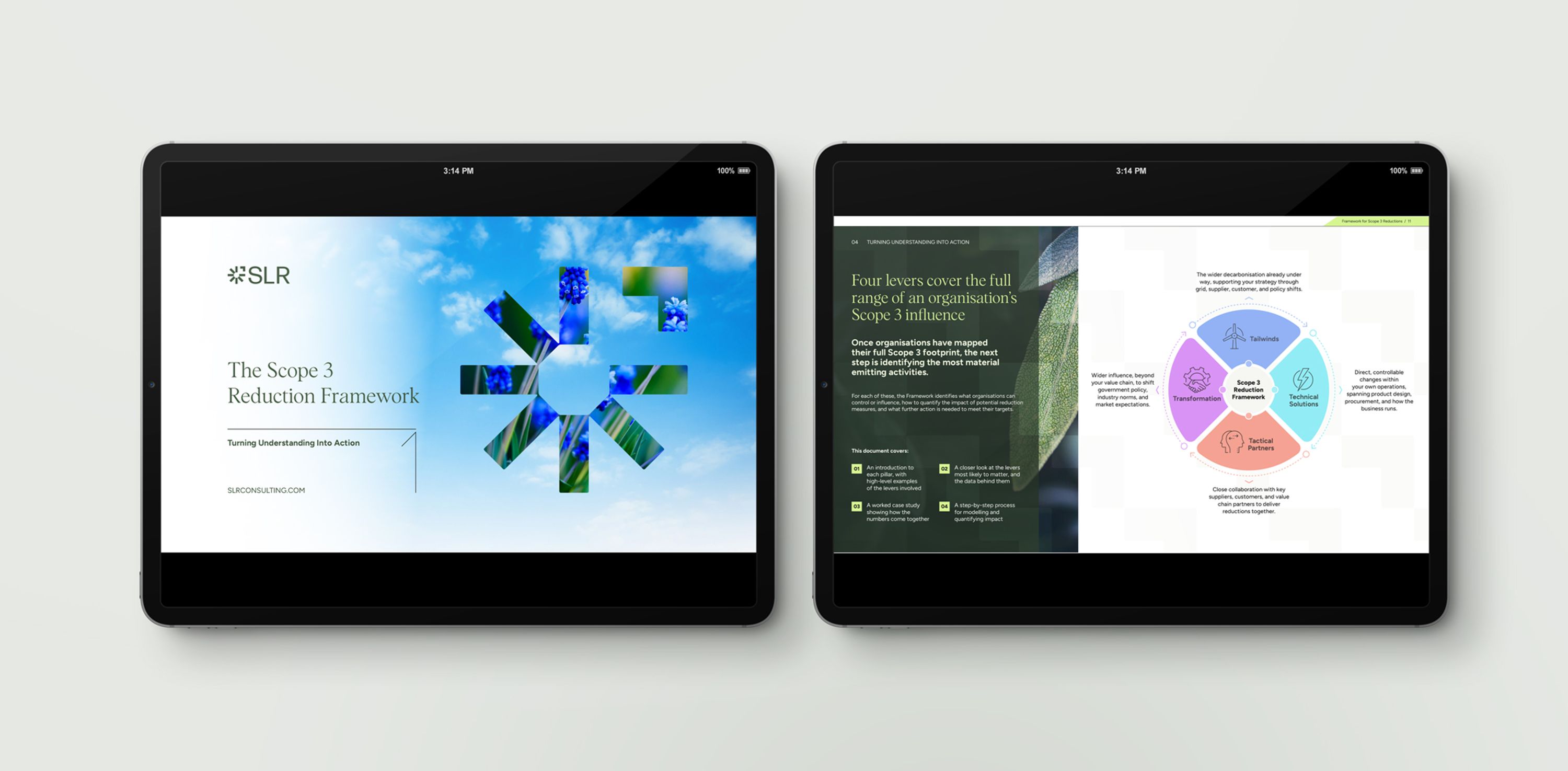
Download the framework using the form below to understand where your own scope 3 target sits across the four levers, and contact our Climate & Nature advisory team, who can help you build-out the pathway behind it.
by Henry Partridge, James Balik-Meacher, Miguel Oyarbide

by Michael Fenny, Mark Ashby, Claire Willey