Data centre backup power may be temporary, but its air quality impacts aren’t
by Ben Turner
View post

The publication of the framework for CMIP7 marks the most significant shift in the scientific basis of climate scenario analysis since the Paris Agreement (which coincided with CMIP6). Two changes stand out: the current highest global emissions scenarios (SSP5-8.5) are no longer feasible now lower than in the previous scenario sets, while the new lowest emissions scenario no longer keeps warming below 1.5°C throughout the century. For organisations conducting climate risk assessments, project planning, or navigating mandatory disclosure frameworks, both shifts have direct practical consequences.
CMIP7 introduces seven new scenarios from High to Very Low. This simplifies the current naming convention with descriptive tier labels to better reflect each pathway.
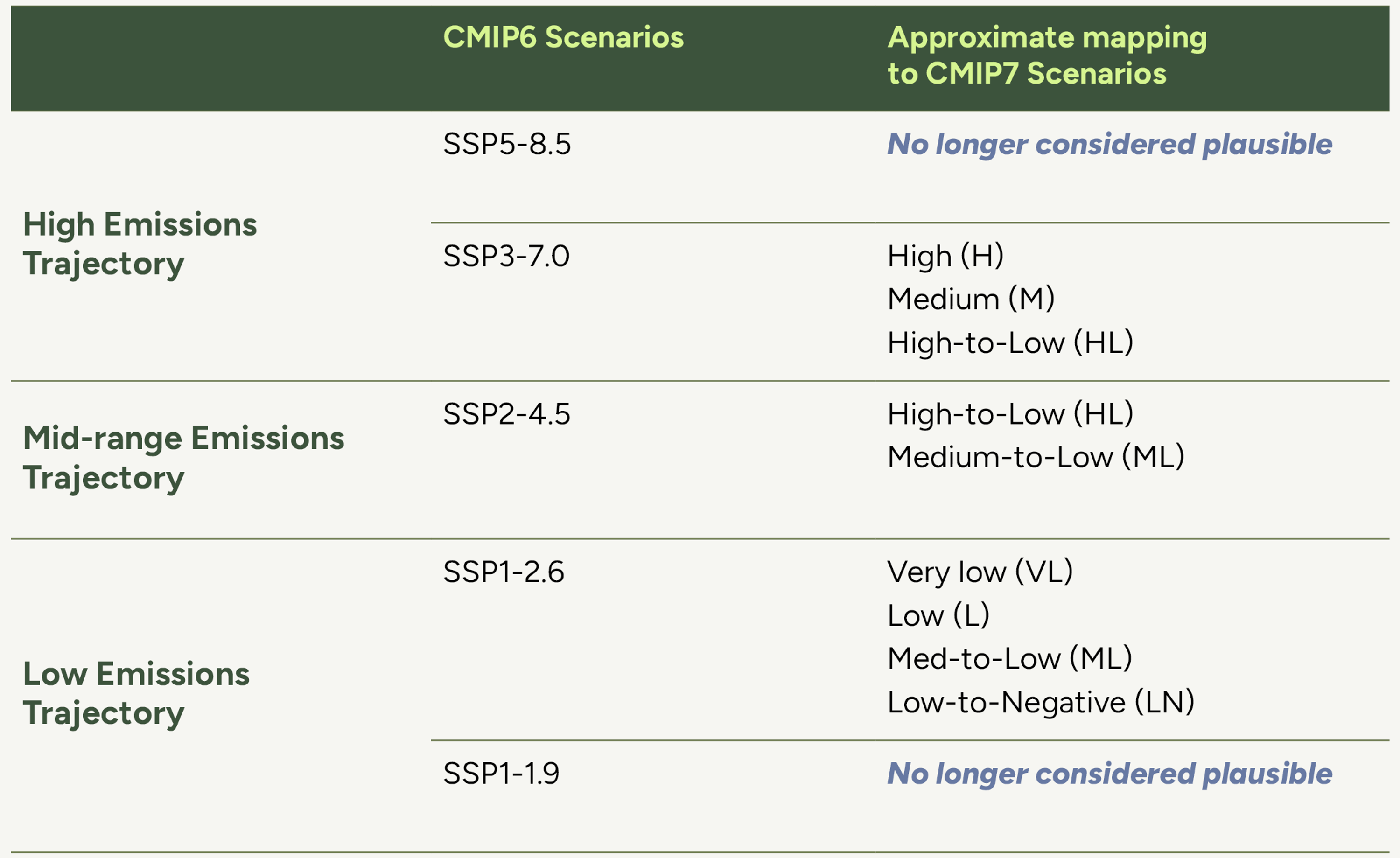
In designing CMIP7, the scenario development team reassessed questions of plausibility that had been raised in the scientific literature for the most extreme CMIP6 scenarios, most notably SSP5-8.5 and SSP1-1.9, in alignment with the world’s latest emissions trajectory. That process produced a range that no longer includes the most extreme ends of the CMIP6 set. The table compares the old and new scenarios, based on the projected 2100 temperatures:
There are three critical takeaways from this:
The transition from CMIP6 to CMIP7 as part of the planned Intergovernmental Panel on Climate Change (IPCC) cycle raises an immediate practical question: which datasets should organisations use now, and on what basis?
The answer depends on two factors: regulatory context and project purpose.
The global disclosure landscape is varied, but as reporting regimes coalesce around International Financial Reporting Standards (IFRS) S2, companies are being pushed to assess both a high- and low-warming scenario. For many the default has been to use the “extremes” (SSP1-1.9 and SSP5-8.5) in order to test the full range of possible exposure.
As those end-cases are to be phased out, companies should look to the less extreme data sets from CMIP6 (i.e. SSP1-2.6 and SSP3-7.0) to ensure that the analysis focuses on plausible futures, support decision-making, and can be readily translatable once the CMIP7 data is available.
Outside of mandatory disclosure, assessments for project-level climate risk should be driven by their intended purpose, taking into account factors such as the asset's design life, criticality and the consequences of failure. The examples below illustrate how this principle can be applied in practice:
For most organisations, the immediate priorities are:
If your current analysis relies on SSP1-1.9 as the low-warming scenario, that choice will require increasing justification. SSP1-2.6 is the better supported default. If SSP5-8.5 appears as a reference or even ‘business-as-usual’ scenario, that framing needs updating.
Whether for disclosure or project planning purposes, the reasoning behind scenario selection is increasingly subject to scrutiny from auditors, investors, lenders, and regulators. The shift in scientific consensus provides a clear and defensible basis for updated choices, but that basis needs to be articulated explicitly.
Organisations investing in climate risk frameworks now should design them to accommodate CMIP7 datasets as they become available, rather than rebuilding from scratch. The risk logic and governance structures developed under CMIP6 can carry forward; the underlying climate data must be updated.
SLR supports organisations globally with physical climate risk modelling, climate scenario analysis, and mandatory climate-related financial disclosure under IFRS S2 and equivalent frameworks. If you would like to discuss how CMIP7 developments affect your analysis or disclosure approach, please get in touch.