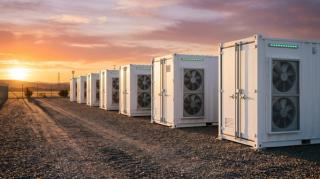
BESS cooling noise: Bridging the gap between modelling and real-world operation
by Arvind Deivasigamani
View post
Battery energy storage systems, or BESS, are becoming an increasingly visible part of the energy landscape. At first glance, battery installations may not seem like an obvious source of noise. The batteries themselves store electricity, charging during periods when energy is available and discharging when it is needed, but there is a lot more happening within a BESS facility.
Charging and discharging generates heat, which means battery containers need cooling systems to keep them within appropriate operating temperatures. There are also inverters, which convert electricity between direct current and alternating current, along with transformers and other supporting equipment. Fans, chillers, compressors, cooling systems, inverters and transformers can therefore all contribute to the acoustic environment.
When hundreds of battery units are installed together, their cumulative impact can become important, particularly where a BESS facility is proposed near residences in areas with relatively low background noise levels. For developers, understanding noise is therefore an important part of planning, design and ultimately operation.
The challenge is making sure the assumptions we use when predicting that noise adequately represent the way a BESS facility will actually operate.
When assessing a proposed BESS facility, acoustic consultants are being asked to predict the noise from something that has not yet been built. Inevitably, that means making assumptions about how the equipment will operate.
One approach is to model a conservative scenario in which all battery units behave in the same way and their cooling equipment operates simultaneously at maximum duty. The resulting overall noise can then be predicted at surrounding receivers and assessed against the applicable noise criteria.
Where that modelling predicts an exceedance, mitigation measures may be recommended. In some cases, this can include assumptions or requirements around the operating capacity of fans and chillers.
There is good reason for taking a conservative approach to environmental noise assessment, particularly when assessing a facility that has not yet been built. The challenge is making sure the scenario we define as the worst case bears a reasonable relationship to how the equipment will actually operate.
In reality, a BESS facility is not necessarily a collection of identical noise sources all operating in the same way at the same time. Cooling demand can vary with battery temperature, ambient conditions and whether the batteries are charging or discharging, meaning individual units can move through different operating states at different times.
Understanding that behaviour is important because it can materially change how we think about the acoustic performance of the facility as a whole.
Consider the cooling system within a single battery container. One control strategy might activate cooling relatively early as the internal temperature rises, allowing the equipment to operate for longer at a lower output. Another might allow the internal temperature to increase further before the cooling system activates at a higher capacity for a shorter period.
Both approaches are designed to manage battery temperature, but they can have different implications for both energy consumption and noise.
Cooling equipment uses energy that might otherwise be stored or supplied to the grid, so manufacturers may design control strategies with energy efficiency in mind. However, a strategy that minimises the cooling system’s own energy consumption may mean the equipment periodically operates at a higher output, which can have different acoustic characteristics from equipment operating continuously at a lower capacity.
That becomes even more significant when we move from thinking about one battery to considering an entire facility.
Operating data presented by Arvind Deivasigamani from a facility with approximately 200 batteries illustrates how dynamic that behaviour can be. Rather than every cooling system switching on and off together, individual units changed operating states at different times. The overall acoustic environment was therefore changing, while a conventional modelling approach may represent those sources as operating simultaneously under the same steady-state condition.
If the system itself operates dynamically, understanding that behaviour should be an important part of developing the acoustic inputs we use to assess it.
An acoustic model is only as useful as the assumptions and data that sit behind it. Where detailed operating information is unavailable, conservative assumptions are understandable, but treating those assumptions as a substitute for understanding the equipment can potentially lead to mitigation that does not reflect how the system will operate in practice.
For example, if modelling based on highly conservative assumptions predicts an exceedance, one response could be extensive noise barriers around a BESS facility. Depending on the project, that could add significant cost when a more detailed understanding of the equipment and its operation may identify a different engineering response. In his presentation, Arvind Deivasigamani noted that extensive noise walls could potentially add several million dollars to a project.
Importantly, better operational data is not about trying to achieve a more favourable modelling outcome. It is about developing an assessment that more accurately represents how the facility is expected to operate, giving project teams a stronger basis for the decisions that follow.
This means looking more closely at questions such as when individual cooling systems switch on and off, how their acoustic output changes with operating capacity, how ambient conditions and battery activity influence cooling demand, and how different operating states across multiple units combine at surrounding noise-sensitive receivers.
The more realistic these inputs are, the better we can understand the potential acoustic impacts and determine what mitigation, if any, is appropriate.
Improving the way we assess BESS noise is not only about creating a more detailed acoustic model. It also requires closer collaboration between the people who understand environmental noise and the people who understand how the equipment actually works.
Acoustic specialists understand environmental noise requirements and how equipment can influence nearby communities. Original equipment manufacturers understand how their batteries, thermal management systems and controls operate. Developers, meanwhile, need to deliver a project that can satisfy planning requirements while remaining technically and commercially viable.
The difficulty arises when those perspectives do not come together early enough.
A noise recommendation developed without a clear understanding of equipment control logic may not represent the most appropriate solution for the system being proposed. Equally, equipment optimised primarily around battery performance and energy efficiency can have acoustic implications that need to be understood as part of the broader project design.
Bringing these perspectives together creates an opportunity to consider noise as an engineering challenge rather than simply something that needs to be mitigated once the design has already been developed.
For example, understanding control strategies, equipment selection, layout and operating modes may help identify different ways of managing acoustic impacts. It becomes a conversation about how the complete system can work, rather than automatically turning to additional physical mitigation as the solution.
There will always be uncertainty when modelling a facility that has not yet been built, and conservative assumptions will continue to have an important role in environmental assessment. But conservatism and realism do not need to be competing objectives.
As the BESS sector evolves, there is an opportunity for acoustic assessment to evolve alongside it. The more we understand about how these systems operate in practice, the better positioned we are to develop credible assessment scenarios, identify genuine acoustic risks and design proportionate responses.
The central lesson is relatively simple: cooling systems within a BESS are dynamic. Their operation can change according to what the battery is doing and the conditions it is operating under, and as that behaviour changes, so too can the resulting noise emissions.
Understanding that relationship requires acoustic specialists and equipment manufacturers to work together, with manufacturers building an understanding of project noise requirements and acousticians developing a better understanding of the equipment and its operating logic. Done well, that collaboration can support engineering solutions that work for the project, the technology and the surrounding community.
As BESS projects continue to grow in scale and complexity, considering acoustics early can help identify potential constraints while there is still flexibility to address them through project design.
At SLR, our approach is to look beyond a single noise prediction and build an understanding of how the proposed system is intended to operate. By working with developers, designers and equipment manufacturers, we can bring acoustic requirements into the engineering conversation earlier and develop modelling inputs that more closely reflect the equipment and its expected operating behaviour.
This provides a stronger basis for assessing potential impacts at nearby noise-sensitive receivers, exploring different design and operating scenarios, and identifying mitigation that responds to the actual sources and characteristics of noise.
Ultimately, the aim is not simply to demonstrate compliance on paper. It is to develop practical, evidence-based acoustic solutions that consider environmental requirements alongside the technical and commercial realities of delivering a BESS project.
Note: Arvind Deivasigamani explored this topic at All Energy Australia 2026, examining the relationship between BESS operating behaviour, cooling systems and acoustic assessment. The presentation was developed as a co-presentation with Valo Energy.