
Reducing Scope 3 emissions: A practical framework for action
by Henry Partridge, James Balik-Meacher, Miguel Oyarbide
View post

A proposed delay to EU MR may provide organizations with additional preparation time, but the regulation's requirements remain unchanged. SLR's methane emissions experts share practical measures companies can implement now to improve compliance readiness and reduce future implementation challenges.
Driven by concerns over high energy prices, supply security, and geopolitical instability affecting global energy markets, the European Union is considering a delay to its landmark Methane Regulation. In addition, stakeholders continue to face uncertainty around key implementation details of the import requirements, including Measurement Reconciliation and Verification (MRV) equivalency, accepted verification approaches, compliance pathways, and the treatment of complex Liquified Natural Gas (LNG) supply chains, leading some to argue that additional time is needed to establish workable compliance mechanisms.
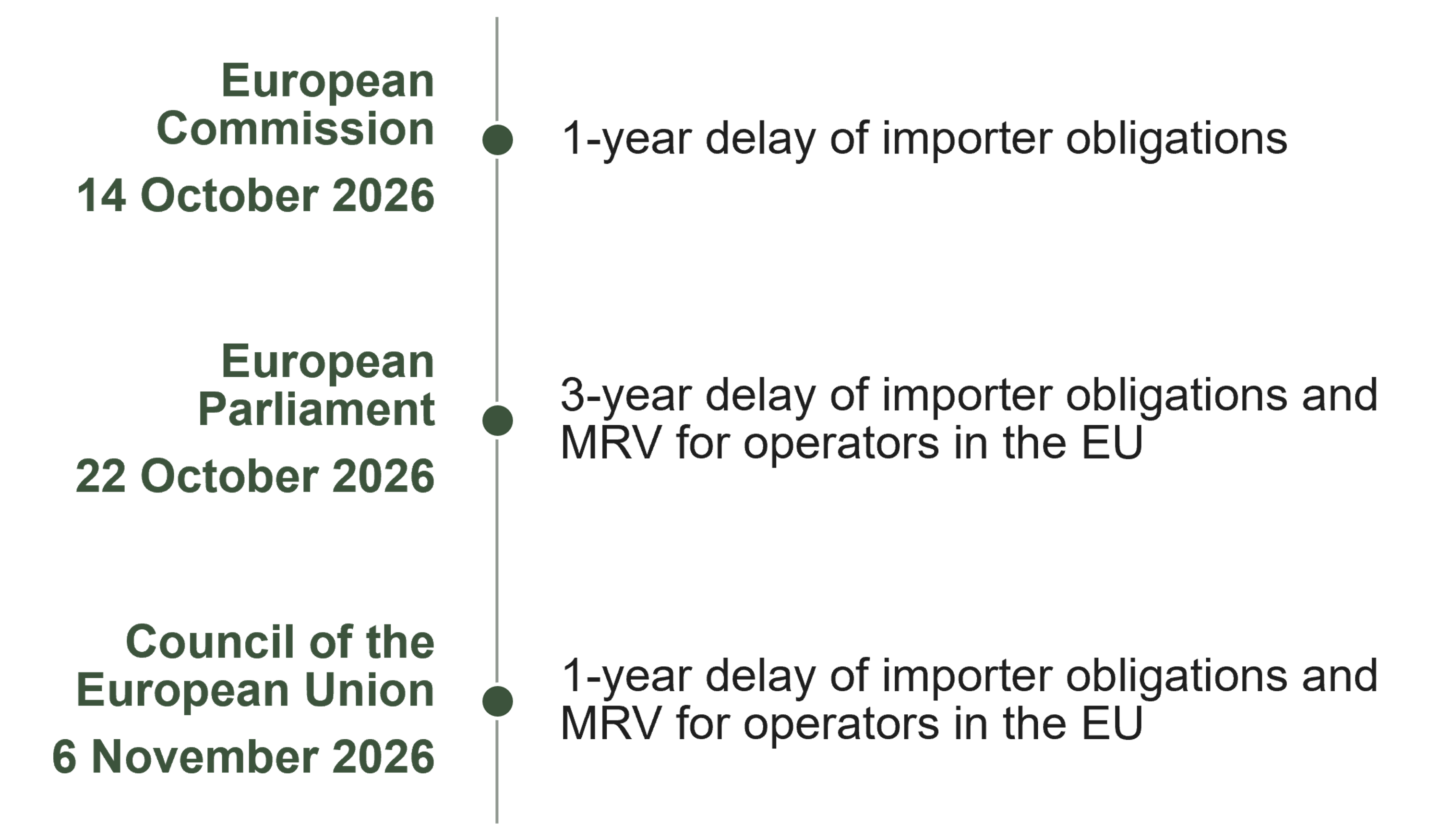
Key legislative and executive institutions have now proposed slightly different delays of the rule. Because the proposals are all slightly different, these institutions must enter a trilogue to negotiate a final action. Without final action MRV requirements in the rule will be effective starting January 1, 2027.
Operators throughout the supply chain can use a delay to make sure they are ready when the MRV aspects of the rule are effective. Readiness activities are discussed further below and include:
On October 14, 2026, the European Commission proposed a legislative amendment to postpone certain reporting-related obligations under the EU Methane Regulation by one year. Specifically, the proposal would amend Articles 28 and 29 to delay importer reporting obligations, as well as methane-intensity reporting requirements applicable to both EU producers and importers.
On October 22, 2026, the European Parliament voted in favor of a more extensive, three-year delay to the requirements under Articles 28 and 29, compared with the one-year postponement proposed by the Commission. In addition, Parliament proposed a three-year extension to the deadlines for verified source- and site-level reconciliation reporting by EU oil and gas operators under Article 12.
Most recently, following its meeting on November 6, 2026, Council of the European Union published its position. The Council agreed with the Commission's proposal to delay the requirements under Articles 28 and 29 by one year. However, it also proposed a one-year postponement of the Article 12 source- and site-level reconciliation requirements. This goes beyond the Commission's proposal but is two years shorter than the delay proposed by Parliament.
The Council also proposed amendments to Article 32 requiring the Commission to assess, after one year, whether key elements needed to implement the reporting obligations are in place. These include the availability of a sufficient number of third-party verifiers, the existence of equivalent third-party verification and monitoring procedures in third countries, and implementing rules governing the transfer of information between producers and importers. If these conditions are not met, the Commission would be empowered to adopt a delegated act postponing the application of import-related monitoring obligations by an additional year.
The Council will now seek an early agreement with the European Parliament to ensure that the proposed postponement can take effect before the end of the year. Barring legislative action, the original requirements of the EU MR will remain in effect, including the January 1, 2027 start date under Article 28 for importers with contracts concluded or renewed after August 4, 2024.
The proposed delay should not be viewed as an opportunity to maintain business-as-usual practices. Both the European Commission and European Parliament have reiterated that the objective and scope of the EU Methane Regulation remain unchanged. Rather, the additional time should be used to strengthen methane measurement, reporting, verification, and supply-chain transparency processes in anticipation of future compliance obligations.
While implementation details continue to evolve, organizations can take practical steps over the next year (or years) to improve preparedness. We propose the following as key preparatory measures, designed to move you closer to the finish line while recognizing the proposed delay is partially to allow more time for the verification mechanisms to develop.
Organizations should evaluate whether their existing methane measurement programs can support source-level and site-level reporting requirements.
For producers that have not yet implemented source-level measurements, the delay period provides an opportunity to align measurement programs with OGMP 2.0 Level 5 expectations and the associated technical guidance documents. These frameworks are widely viewed as the current benchmark for measurement-informed inventories and are recognized directly in the regulation as “state-of-the-art industry practices”.
Potential activities include:
Organizations should consider completing a mock-audit or “readiness assessment” exercise to simulate a reasonable level of assurance before regulatory compliance deadlines take effect. Third-party verification implementation details remain one of the largest gaps in complying with the EU MR. While the standard and recognition of auditors continues to develop, operators can utilize tools available now to flag gaps and take corrective action prior to the start of compliance obligations.
This can be completed through:
These exercises can help identify weaknesses in data quality, documentation, controls, and governance before formal verification becomes required.
One of the most significant challenges associated with the import provisions is the need to obtain information from multiple parties in the supply chain. Organizations should use the delay period to establish communication channels and data-sharing expectations upstream and downstream.
Developing these relationships now will reduce the risk of data gaps later when reporting requirements become enforceable.
Given the continued uncertainty around compliance pathways, organizations should begin evaluating available platforms to manage Compliance Solutions as recognized by the Commission’s recommendation.
Key considerations include:
Organizations should also evaluate opportunities to digitize data collection and reporting workflows to improve transparency, reduce administrative burden, and facilitate future audits.
The delay period provides an excellent opportunity to test future compliance processes before they become mandatory. What may seem simple on paper could raise practical implementation challenges. Avoid completing an MRV activity for the first time under compliance obligations (whether directly obligated or tangentially).
Potential pilot activities include:
The objective should be to identify operational, technical, and governance challenges now rather than during a regulatory reporting cycle.
Although the implementation timeline may ultimately be extended, the underlying requirements of the EU Methane Regulation remain unchanged. Organizations that use this period to strengthen measurement programs, engage their supply chains, evaluate compliance solutions, and conduct pilot exercises will be significantly better positioned when reporting, verification, and methane-intensity requirements ultimately take effect. The delay should therefore be viewed as additional preparation time, not a pause in compliance planning.
SLR's teams have extensive experience in MRV program development, life cycle assessment (LCA) for natural gas, and audit support. SLR staff have decades of experience crafting MRV plans and achieving successful implementations under the OGMP 2.0 program. We can help organizations evaluate readiness, identify compliance gaps, engage supply-chain partners, test reporting and verification processes, and develop practical implementation roadmaps aligned with evolving regulatory expectations.
We can also provide an independent review of an organization's existing program and identify opportunities for improvement before formal audit requirements take effect.
As an independent and trusted advisor, SLR provides objective guidance on measurement technologies, monitoring approaches, and reporting solutions. Because we are not affiliated with any specific software platform or technology provider, we offer recommendations tailored to each organization's operational realities, compliance objectives, and business priorities.
Our team has hands-on experience deploying measurement technologies, developing measurement-informed inventories, and supporting methane mitigation programs across the natural gas value chain through voluntary initiatives such as OGMP 2.0 and MiQ, as well as regulatory programs including the Colorado Methane Verification Program.
SLR is also a recognized independent third-party auditor under the MiQ standard, having conducted audits for both producers and LNG importers.
Contact us
by Henry Partridge, James Balik-Meacher, Miguel Oyarbide
by Valeria Alvarado Tejeda, Selina Roman-White

by Michael Fenny, Mark Ashby, Claire Willey