Data centre backup power may be temporary, but its air quality impacts aren’t
by Ben Turner
View post
The UK has some of the highest industrial electricity prices in the world, presenting major challenges for UK manufacturing businesses. These include reducing the potential for investment and harming competitiveness at an international level. Against this backdrop, in April 2024, the UK government released the British Industry Supercharger (BIS) to support energy-intensive industries (EIIs) [1]. This, however, was not deemed to go far enough, and in August 2026, the UK government announced the British Industrial Competitiveness Scheme (BICS) [2].
Where BIS covers just ~ 600 businesses classified as EIIs, over 10,000 businesses in Great Britain (NI excluded) are expected to be eligible for BICS.
BICS will remove a range of indirect policy costs from electricity bills, namely Renewables Obligation, Feed-in-Tariff (FiT), and Capacity Market. It is expected to reduce an average electricity bill by around 25% for eligible manufacturers – those in either frontier (IS8) or foundational industries.
The UK government released its BICS guidance on 10 August 2026, and our team has sifted through it and picked out the critical information that manufacturers need to know.
BICS is targeted at electricity-intensive manufacturing businesses, including:
Eligibility is determined principally through SIC and HS product codes, supported by sector-level electricity intensity thresholds which the UK government has already determined [3],[4].
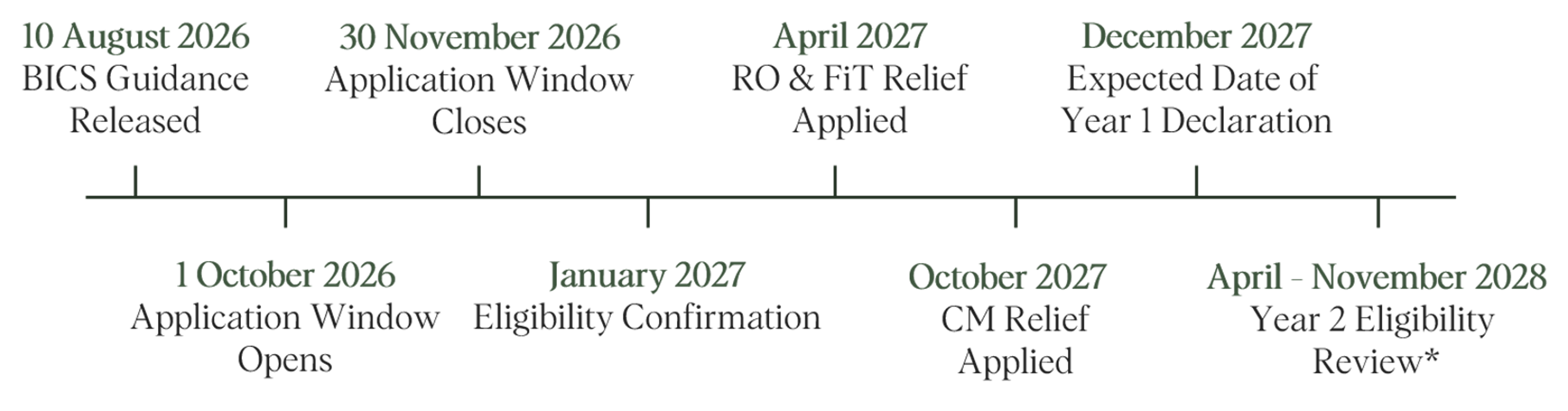
If, having examined your SIC code and HS codes, you believe you are likely to qualify for BICS, this is where the heavy-duty work will start - calculating site by site eligibility and getting your application ready for when the portal opens 1 October 2026.
The level of exemption given to each site is based on the percentage of electricity used that goes towards eligible manufacturing activities. The three exemption bands are:
To clarify, if more than 50% of site electricity goes towards eligible activities you will receive a 100% exemption applied to all site electricity usage.
At a topline perspective, the initial application consists of:
Successful applicants will also need to make annual declarations out to 2030 and undertake a full eligibility review in 2028.
Further detail can be found in our briefing note appended to this article.
The UK government's detailed BICS guidance and evidence requirements are extensive and require time to break down into workable chunks. Our BICS Programme team can support you to:
We offer a transparent fixed-fee approach rather than a percentage of savings model. Whether it is to lay the foundations to get manufacturers going with their first application, or managing BICS across the full programme cycle, get in touch with our experts if you require support.