Understanding traffic and transport risks in onshore wind projects
by Charlie Seventekin, Ian Cronshaw
View post

Hello and welcome to the July 2026 edition of our Carbon and Energy Newsletter.
In this month’s issue, we will provide a debrief on the UK Carbon Border Adjustment Mechanism (CBAM) highlighting what it is, when it is coming into force, who is affected and how to prepare. The EU CBAM is already in its first year of implementation, however with potential significant changes already on the horizon, the divergence to UK CBAM could create compliance complexity for companies trading in both directions. It’s also that exciting time of the year when the latest UK government emission factors are released, so we will be reviewing some of the significant changes from the previous year caused by methodology updates. We will then finish up with some new revisions on UK ETS and a taster download on the new SBTi V2.0 guidance.
It’s been hot! Breaking many records, the recent UK heatwaves have been unbearable at times but is it becoming a new normal?
In both May and June of this year, temperatures reached over 35°C in areas across the UK - this follows the UK’s warmest year on record in 2025. Scientific evidence states that this is an undeniable result of climate change with further heatwaves expected and additional records anticipated to be broken. Research published by the Imperial College London found that during the recent UK heatwaves, around 2,700 people had died from overheating of which 1,100 were identified as being a result of the climate crisis [1]. The immediate impacts of climate change are already starting to show and demonstrate the requirement for climate adaptation and resilience planning across businesses, communities, and infrastructure. Whilst we also need to push for achieving a rapid response towards net zero targets, it is obvious that vulnerable communities are already being affected and further extreme impacts are to be expected.
So, whilst you’re trying to keep cool during these heatwaves, it’s also an important time to reflect on what we can do to improve our climate resilience and net zero planning.
The UK Carbon Border Adjustment Mechanism (CBAM) is a scheme that mirrors its sister EU initiative already in place and seeks to address the risk of carbon leakage in specific sectors. Coming into place from the 1st January 2027, UK CBAM will apply to carbon intensive products imported from outside the UK across the following five sectors:
It will ensure these products face a comparable carbon tax to UK manufacturers producing the same goods and will be based on embodied emissions. Importers can use either the actual emissions data (which must be independently verified) or a default emissions set by HM Treasury. CBAM rates will then be set by reference to the UK ETS allowance auction price adjusted to reflect emissions covered by free allowances.
So what should you do if you think that this might impact your business? Begin preparing for your potential reporting obligations:
1st January 2027 is fast approaching, therefore getting a head start on the data requirements is highly recommended and SLR are available to provide support.
The EU Carbon Border Adjustment Mechanism (CBAM) could soon apply to a much broader range of imported goods. Earlier this month, the European Parliament’s Environment Committee adopted a proposal to significantly expand EU CBAMs scope, by including additional downstream carbon-intensive products. Proposed additions include methanol, steel mesh, cooking equipment, heat pumps, agricultural machinery, and finished steel and aluminium products such as fasteners, wire, and springs. If approved, importers of these products would face additional carbon costs when accessing the EU market.
Other key points agreed by the committee include:
This does remain a European Parliament negotiating position, not final regulation. Scope and details can still change during negotiations.
Specifically for the UK, the widening gap between the EU’s expanding scope and the UK’s narrower CBAM (covering aluminium, cement, fertiliser, hydrogen, iron and steel from January 2027) is worth considering. Divergence could create compliance complexity for companies trading in both directions.
The latest UK government conversion factors have been released for 2026 reporting [3].
There have been a few changes to digest from 2025, but our immediate attention is always brought to the UK electricity emission factor. This has reduced by 26% following a new approach reducing the lag in the grid mix data used in calculations from two-years to one-year. The 2026 factor therefore reflects two years’ worth of changes in the electricity grid mix rather than the usual one year.
This drop in the electricity factor has had knock-on impacts to other factors, particularly those associated with electric vehicles e.g. business travel and freighting goods. The homeworking factor was also impacted but to a greater magnitude (31% reduction) due to not previously being updated since 2022.
Other notable changes on the emission factors include those to the various scope 3 rail factors. These have seen a significant drop on the most part: national rail (-13%), light rail and tram (-26%), London underground (-45%), as they were based on estimates prior to the COVID pandemic. International rail on the other hand has increased by ~155% due to large changes in estimates prior to COVID based on service patterns and rolling stock utilisation [4].
UK Compliance Report - Emissions and Surrenders
A 2026 report has been released providing details on reported emissions under the scheme [5]. It gives key insight into the year-on-year changes and largest contributors. The table below provides a breakdown:
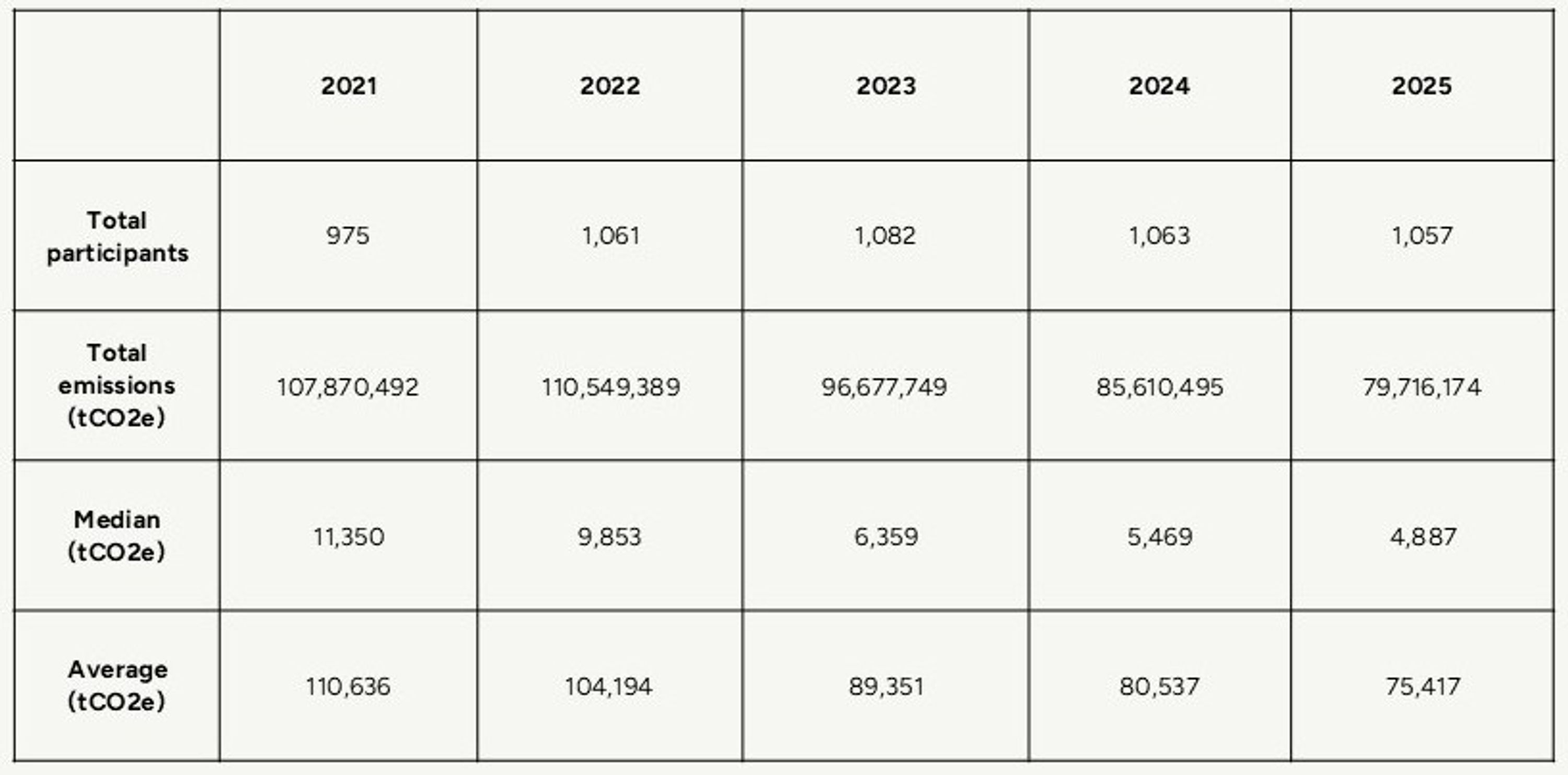
This showcases that post COVID, from 2022, total emissions have shown a year-on-year reduction whilst maintaining a stable participant number. Of this, most emissions reductions (-96%) were in industrial sectors with a modest reduction (-4%) in aviation. Iron and steel saw the highest relative decrease in emissions by 2.8mtCO2e (-44% from 2024 levels) primarily due to Port Talbot steelworks’ closure of blast furnaces.
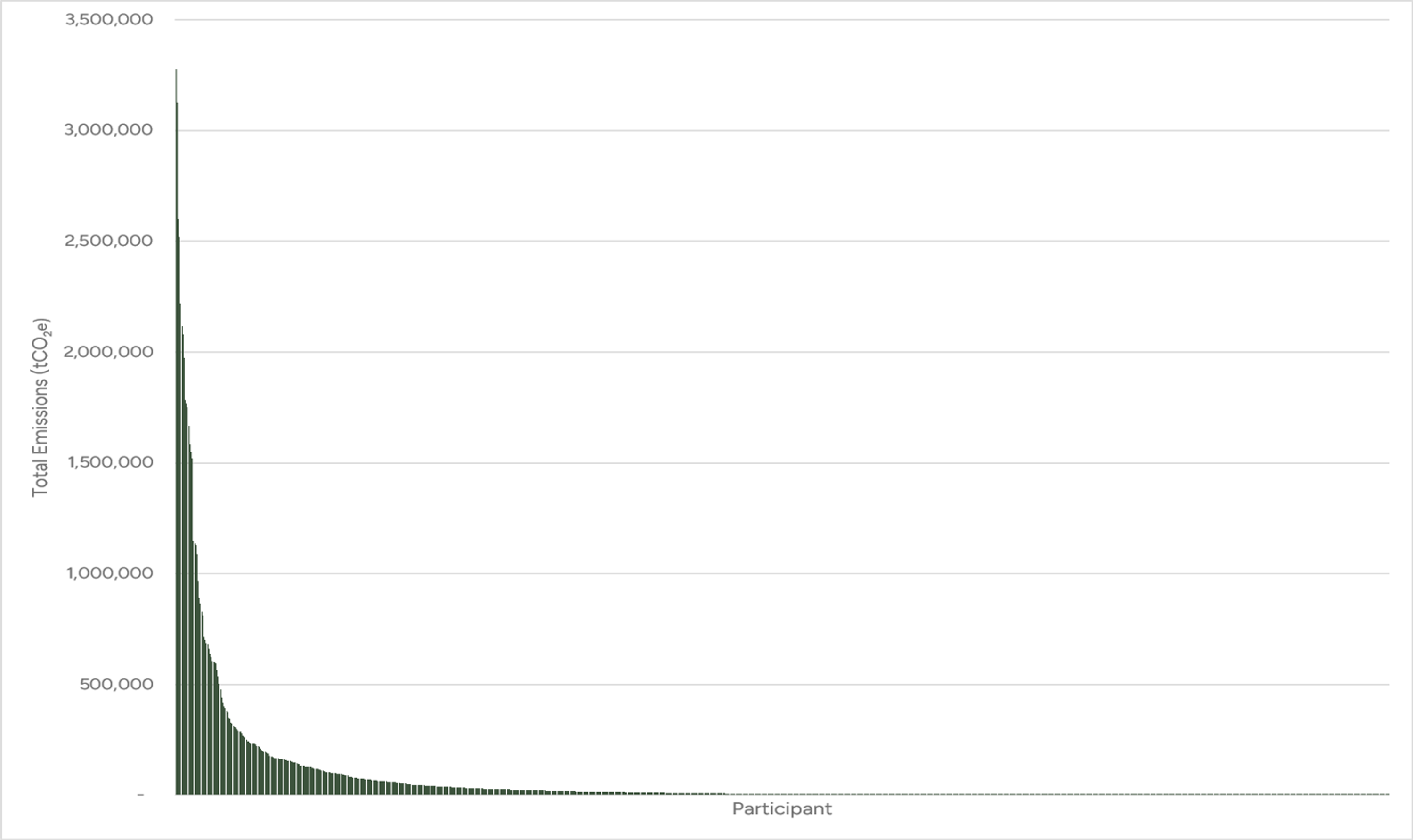
The data also highlights that most emissions come from a small number of participant emitters. A review of the top 20 emitters (out of 1,057) found that combined emissions equated to 37mtCO2e (46% of the total). These primarily come from ‘production of electricity’ with other significant contributors including ‘manufacture of refined petroleum products’, ’extraction of crude petroleum’, ‘manufacture of cement’ and ’extraction of natural gas’.
We previously highlighted [6] that recent markets have been showcasing a significant fluctuation in carbon price across the UK & EU ETS. After a substantial drop in March, the markets showed a consistent increase on price. UKA price is currently around £61/tonne and EUA prices around €83/tonne [7].
The Science-Based Targets initiative (SBTi) has released its first major revision to the Corporate Net Zero Standard providing new guidelines in its Version 2.0. Having recognised the barriers that companies have experienced to date in efforts to deliver against their targets, the SBTi has developed an updated framework to act as a more practical toolkit. The updates are intended not only to support companies to define their ambition in line with the latest climate science, but go beyond and support target implementation.
The SBTi has introduced several significant updates and new requirements including the need for:
SLR will be releasing further detailed communications on the implications of the Corporate Net Zero Standard V2.0, what it means for businesses, and how SLR can ease the burden.
SLR has an experienced team who specialise in energy efficiency and decarbonisation to support companies in identifying opportunities and formalise procedures in capturing this information year-on-year. Please contact us if you would like support.