Decarbonising the invisible journey: DP World's carbon insetting programme
- Client Name
- DP World
- Location
- United Kingdom
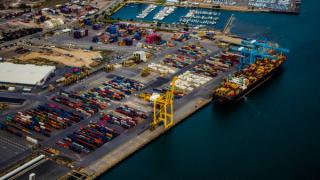
For retailers and importers in the United Kingdom, containerised trade is part of everyday business. From fresh berries grown in Morocco to footwear manufactured in Indonesia, goods begin their journeys thousands of kilometres away, moving through a complex and highly coordinated global logistics system before reaching shops and consumers across the UK.
A typical container journey involves multiple stages: leaving a factory or site of production, being packed and sealed, transported to a port of export, and loaded onto a vessel. It then travels across oceans, arriving at a UK port where pilot vessels and tugboats guide it safely to berth. From there, the container passes through a highly sophisticated terminal operation: one that manages throughput, safety, customs requirements and timing with precision, before exiting the gate and continuing by road to distribution centres and retail locations across the country.
For an island economy such as the UK, and one that relies heavily on imports, this process is pure routine. Yet from a decarbonisation perspective, it presents a significant challenge. In this project summary, we share more about SLR’s work to reduce the carbon intensity across DP World’s value chain.
Challenge
A fragmented system, difficult to decarbonise
Each step of the container journey carries its own emissions profile and its own technical and operational constraints. Marine fuel choices, port equipment, terminal energy use, hinterland transport and data availability all vary widely. Many of these emission sources are hard to abate in isolation, and even harder to address collectively.
For retailers and beneficial cargo owners (BCOs), the challenge is compounded by distance from the assets that generate emissions. They are often several steps away from vessel operators, port infrastructure owners, and terminal operators. This lack of proximity and control can make it difficult to understand where emissions occur, let alone how to influence them.
Without new approaches, this fragmentation risks becoming a weak link in the journey to low carbon operations and products. But, for early movers in the logistics industry, it can also be viewed as an opportunity.
Value chain decarbonisation
Every organisation sits within a value chain. Every value chain carries emissions. For most organisations, these ‘Value Chain emissions’ [Scope 3] dwarf the emissions from their direct operations and energy consumption [Scopes 1 & 2].
Value chain emissions are notoriously hard to address because:
- They often focus on hard-to-abate sectors (glass, steel, fertiliser, freight, etc.) which are expensive to decarbonise.
- The data traceability of carbon emissions fails to follow the product to the final consumer.
Carbon insetting provides a way to bridge both those gaps.
A practical lever for change
Carbon insetting is increasingly recognised as a key lever for driving meaningful emissions reductions within complex value chains. Rather than offsetting emissions externally, insetting focuses on reducing emissions within a company’s value chain itself, where operational changes can deliver real, measurable impact.
This approach is gaining traction across the sustainability landscape, including through the work of the Science Based Targets initiative (SBTi), the GHG Protocol, the Taskforce on Climate-related Financial Disclosures and Transparency initiatives, as well as standards and platforms such as Verra, TCAT and AIM Platform. In parallel, commercial logistics providers are beginning to offer customers lower‑carbon services, from alternative marine fuels and electrified vehicles to, for the first time, low‑carbon container terminal operations.
Solution
1. Building an integrated insetting strategy
SLR is proud to have supported DP World, a world leader in end-to-end supply chain solutions, in the development of their Carbon Inset Programme – an initiative designed to help their customers demonstrate measurable improvements in the carbon intensity of marine container freight activity within their supply chains.
Working in close collaboration, the teams developed an integrated strategy that connects operational decarbonisation at terminal level with the requirements of customers seeking credible, future‑ready emissions reductions within their supply chains. The programme is designed to be commercially viable, transparent, and aligned with evolving international frameworks and expectations.
By focusing on emissions reductions within their port and terminal operations in the UK, DP World’s approach demonstrates how infrastructure operators can play a critical role in enabling customers to progress their own decarbonisation journeys; turning a traditionally opaque part of the supply chain into a source of measurable climate action.
2. Enabling decarbonisation where it matters
As global trade continues to rely on containerised shipping, the importance of addressing emissions across ports and terminals will only grow. Carbon insetting offers a pathway to do so in a way that is practical, scalable and grounded in real operational change.
The DP World Carbon Inset Programme now covers the full range of emissions associated with a container’s port call at Southampton, from the marine fuel used by the arriving vessel, to pilot and tug operations, through to the energy and equipment used in container terminal operations. Through this programme, DP World can offer customers a traceable, transparent, and independently audited certificate that evidences the lower‑carbon impact of its operations, going beyond business‑as‑usual decarbonisation efforts. This enables UK retailers and other value‑chain participants to access verifiable emissions reductions to support their value‑chain decarbonisation objectives.
Developed in collaboration with Bureau Veritas, 123Carbon and SLR, the programme positions DP World as a global leader in operational carbon insetting. And beyond our client’s organisation, it shows how collaboration, robust data and integrated strategy can help unlock a lower-carbon future for both logistics providers and their customers.
Impact
Insetting can deliver direct scope 3 reductions for downstream participants…
For downstream value‑chain participants, insetting offers a practical mechanism to deliver Scope 3 reductions by investing in emissions reductions where they occur, whether in logistics, materials, energy, or industrial production.
If your Scope 3 strategy does not yet incorporate insetting, there is likely untapped potential within your supply chain, from transport and infrastructure to steel, cement, fertiliser, aluminium, ammonia and other carbon‑intensive inputs.
… and offer direct commercial upside to incentivise scope 1 & 2 reductions for upstream value chain actors.
At the same time, for upstream producers and asset owners - from miners and manufacturers to processors and infrastructure operators - decarbonisation can become more than a compliance exercise. When low‑carbon production or services can be robustly quantified, verified and reported, they can be transformed into insets that deliver tangible value to downstream customers with net zero and sustainability commitments.
If your organisation is looking to understand how insetting can strengthen your Scope 3 strategy, or how your own decarbonisation progress could generate value for customers across your value chain, SLR can help design, quantify and implement insetting approaches that work in practice, across sectors and geographies.
Get in touch with our team