
Turning responsible purchasing practices into business as usual
- Post Date
- 27 August 2026
- Read Time
- 10 minutes

In 2004, we published Buying Your Way into Trouble. At the time, it challenged a widely held assumption that labour standards, environmental impacts and ethical issues in supply chains were primarily the responsibility of suppliers.
Instead, it argued that organisations often create - or at least contribute to - many of those challenges through the way they buy. This was a relatively new way of thinking. Sustainable sourcing programmes were still largely centred on supplier compliance. If something went wrong, the instinct was to ask what the supplier needed to do differently.
Twenty years later, we revisited that argument in Human Rights and the Supply Chain: Buying Our Way into Trouble. By then, the landscape had changed considerably.
Human rights due diligence had become firmly established, legislation was gathering pace, and businesses were under increasing pressure to understand the impacts occurring throughout their supply chains. Reflecting on the report titles, our substitution of "Your" with "Our" was a conscious decision that echoed the view that these issues were a shared responsibility.
Two years on, the conversation has evolved again.
Few organisations today would dispute that purchasing practices influence supplier behaviour. The evidence is well established. Initiatives such as ACT, Better Buying and a growing body of international guidance have all reinforced the link between commercial decisions and sustainability outcomes.
The real difficulty is operationalising good purchasing practices in commercial models that are just not set up for it.
We've become better at identifying risk, but preventing it is still difficult
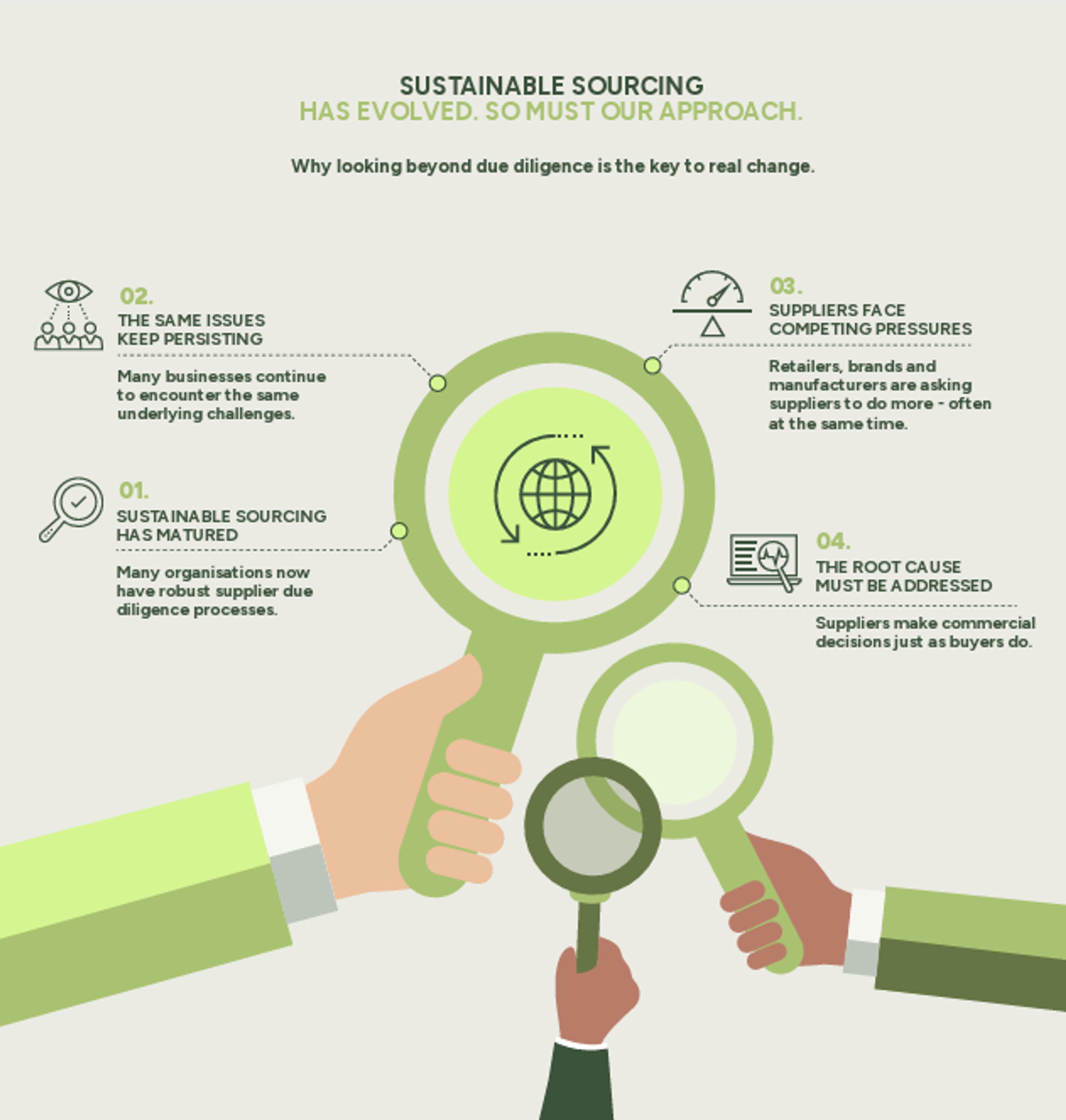
Sustainable sourcing has matured enormously. Many organisations now have robust supplier due diligence processes. They carry out risk assessments, conduct impact assessments in risk hotspots, operate grievance mechanisms, engage suppliers more strategically and increasingly use data to prioritise where they intervene.
These developments have been important and have undoubtedly improved visibility into supply chain risks and impacts. Yet many businesses continue to encounter the same underlying issues: excessive overtime, unauthorised subcontracting, labour shortages, worker turnover and poor recruitment practices.
When this happens, organisations often strengthen their supplier due diligence programmes – they commission more audits and implement action plans, and they deliver training to the impacted suppliers. Sometimes these measures are exactly what is needed. But they rarely address the commercial environment in which suppliers are operating.
Across our work with retailers, brands and manufacturers, we continue to see suppliers trying to reconcile competing customer expectations: improve labour standards while absorbing further cost reductions; invest in long-term capability while responding to increasingly volatile demand; improve transparency while managing compressed lead times and late-stage order changes. In one purchasing practices review we carried out for a major retailer, suppliers consistently cited forecast volatility and last-minute order changes as the reasons they needed to rely on unauthorised subcontracting. Audits had raised concerns about subcontracting, but weren’t able to explain why those issues kept recurring. Suppliers make commercial decisions just as buyers do. When conditions become increasingly difficult, they adapt in ways that may not always be visible to their customers.
If we continue to treat the symptoms and not the root cause, we will never be able to solve the problem.
Speaking procurement’s language
When we first started talking about purchasing practices, much of the conversation focused on raising awareness – helping organisations understand what purchasing practices are, and how they might be relevant within their business. Today, awareness is rarely the issue. Most sustainability teams understand the importance of responsible purchasing. Increasingly, procurement leaders do too. The challenge is changing the systems, incentives and behaviours that influence buying decisions every day.
Buying teams operate in a complex commercial environment. They are balancing customer demand, inventory, cost pressures, profit margins, supplier performance, and business growth, often under tight deadlines, against competitors and changing market conditions.
It is unrealistic to expect sustainability objectives simply to override those commercial realities. Equally, it is unrealistic to expect organisations to improve supply chain outcomes without engaging the people making those commercial decisions.
One of the most consistent lessons from our work has been that purchasing practices are often approached as a sustainability initiative when they should be approached as a business one. Procurement teams are responsible for sourcing products, managing supplier relationships and delivering commercial outcomes. So, tackling the potential human rights impacts of buying practices needs to start there.
When conversations begin with legislation, reporting requirements or sustainability frameworks, engagement can be limited - not because buyers, merchandisers and supply chain managers are unwilling, but because the discussion feels removed from the decisions they make every day.
We've found a different approach works better. Start with the commercial reality. Talk about forecasting accuracy, supplier performance, resilience, production planning and communication. These are all part of the critical path to get the product from the supplier to the buyer. Discuss what can go wrong and why it goes wrong, how this impacts the buying process, and the knock-on effect for suppliers and their workers.
Putting the buyer in the supplier’s shoes
One of the most effective ways we've found to engage buyers is to bring supplier voices into the conversation. We’ve done this through supplier surveys and supplier video interviews.
We’ve found suppliers can be very candid when asked about what can go wrong in the buying process. Buyers immediately understand the commercial consequences of changing forecasts, compressed lead times or last-minute specification changes when they hear directly from the suppliers managing those challenges.
For another client, we developed a series of role play scenarios with buyers, merchandisers and supply chain staff taking on the role of buyer, supplier and worker to understand how poor critical path management impacts along the value chain.
Rather than asking procurement teams to become sustainability specialists, help them understand where their decisions create opportunities - or pressures - within supplier operations, and how this can then impact the workers in their supply chain.
A good resource here is the ACT Accountability & Monitoring Report. This bi-annual report of buying practices in the fashion supply chain is based on the largest purchasing practices survey of both suppliers and fashion brand colleagues, and provides a wealth of insights from both perspectives.
Better buying is a competitive advantage
Perhaps the biggest shift since 2004 is that purchasing practices are no longer just a sustainability issue. Speaking to colleagues who are working with clients to develop sustainability strategies, it's apparent that there is increasing awareness of how procurement policies and practices present both financial risks and opportunities over the short, medium and long term.
Purchasing sits within broader business priorities: supply chain resilience, supplier retention, quality, productivity, human rights, decarbonisation, and business continuity. These all depend, to some extent, on the quality of buyer-supplier relationships.
Rather than viewing purchasing practices as another sustainability workstream, they are integrating them into procurement capability, supplier relationship management and commercial governance.
What we've learnt
We have worked with many different businesses across a number of sectors over the last 20 years to help them understand how their purchasing practices are impacting their supply chains. Those that have made significant change are the organisations that really embed an understanding of purchasing practices into their sustainable sourcing programmes.
This means that purchasing practices are owned by a number of different functions in the business and recognised as a corporate issue, rather than sustainability working in isolation.
Supplier feedback is vital, and you might not get it immediately. We have found that to have truly honest conversations, you need to demonstrate to suppliers that you are willing to make adjustments based on what you hear.
If you’re running a survey, in year one, you may only get a handful of insights: digest them, make the changes. Repeat this multiple years in a row before you start to get to the honest reality. Alternatively, engage a third party to interview your suppliers to reassure them that their feedback will remain completely anonymous. Or take part in a collaborative initiative to drive change across your sector (e.g. ACT, Better Buying).
Buyer engagement is most effective when grounded in real commercial scenarios. Good purchasing practices drive positive impacts for a business (product quality, improved resilience, stronger commercial relationships, and a real partnership) and vice versa for negative purchasing practices.
Embedding good purchasing practices supports better, more efficient buying, allowing suppliers to better manage their operations and, in turn, better support workers in the supply chain. Find ways to measure good buying practices. How well is your business delivering to its critical path timescales? How accurate is your business's forecasting? With these insights, your buying and supply chain teams are better able to identify what’s going wrong and why it’s going wrong.
Use these measures to build incentives into the buying process to encourage good behaviour. These could be built into performance appraisals or used to provide insight and comparison across categories.
If success continues to be defined solely through cost, speed and availability, without also considering buying practices (forecasting, critical path management), changing behaviours becomes considerably harder.
And perhaps most importantly, lasting change depends less on publishing and training stakeholders on your new expectations and more on creating the organisational conditions (including reward and recognition) that allow buyers to make different decisions.
Looking ahead
Looking back at Buying Your Way into Trouble, it is striking how many of its conclusions remain relevant. That said, the organisations leading this agenda are no longer asking whether purchasing practices matter.
They are instead asking how commercial decisions, incentives and governance can better support the outcomes they are trying to achieve across their supply chains.
Advisory Digest
Enjoyed this article? For more like it, get SLR's quarterly sustainable business briefing straight to your inbox.
Sign Up
Recent posts
-
-

Data centre backup power may be temporary, but its air quality impacts aren’t
by Ben Turner
View post -