
Implementing sustainable AI: Four key actions for businesses
- Post Date
- 19 May 2026
- Read Time
- 13 minutes

While Artificial Intelligence is increasingly part of our daily lives, recent data leaks and inappropriate uses are causing many individuals and businesses to pause.
International media attention has landed on instances such as the discovery of AI “hallucinations” in Deloitte’s reports delivered to the Australian government in late 2025, or the X platform’s AI agent (known as Grok) producing thousands of inappropriate images upon users’ requests in recent months, which have raised major ethical concerns.
The latter resulted in a raid of the French offices of Elon Musk’s X as part of an investigation by the Paris prosecutor’s cybercrime unit earlier this year, and a separate probe by the UK’s Information Commissioner’s Office (ICO) [1] over Grok’s “potential to produce harmful sexualised image and video content”.
The availability and efficacy of machine learning and AI agents have seen an exponential rise in recent years, and the wide availability of ChatGPT, Claude and CoPilot among an expanding pool of alternative agents has led to rapid adoption by individuals and organisations globally.
The promise of bespoke AI tools that can automate repetitive tasks and enable employees to focus more time on high-value tasks beckons on the one hand. On the other hand, the risk of falling behind peers and losing out on a competitive advantage looms large.
At SLR, we recognise that the “status quo” of AI is not stagnant, and we are continually tracking and anticipating changes in the landscape. However, the following four actions will help your organisation ride the wave of change by sustainably implementing or scaling AI tools.
Taking the social, environmental, and governance implications of your investment into account will support you in future-proofing your investment.
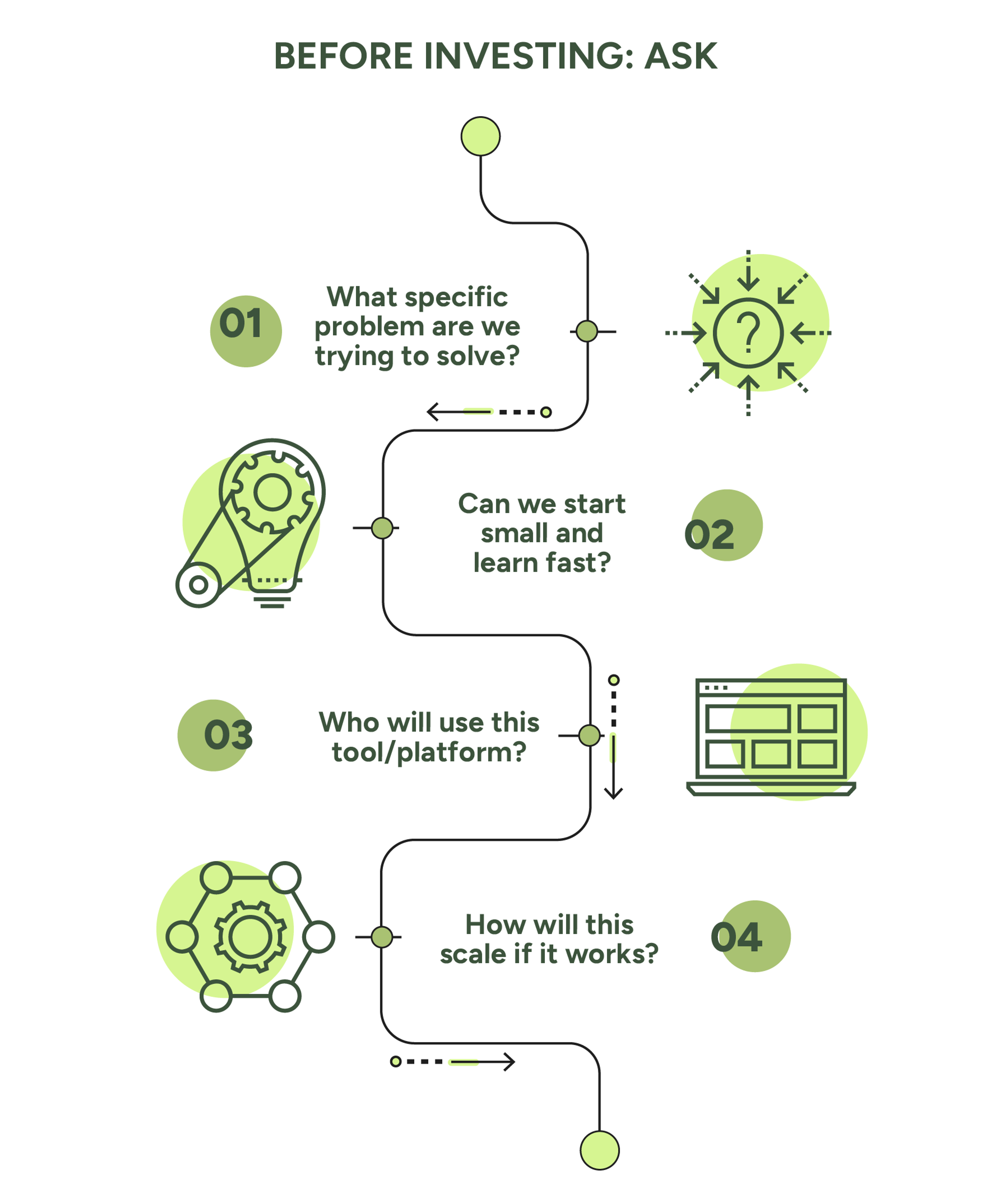
01. Define your why
Before selecting an AI product or scaling its implementation, stop to ask why your business needs it. AI is consistently emerging as a material and strategic topic in our extensive work conducting Double Materiality Assessments for a diverse variety of businesses. Organisations often feel pressure to “do something with AI,” but successful implementation begins with a clear purpose – not technology for its own sake.
When considering your “why”, it is also crucial to recognise that AI itself depends on people: engineers, data scientists, ethicists, policy experts, annotators, and many others behind the scenes. AI is human-made, human-shaped, and ultimately human-dependent.
Despite widespread narratives about AI replacing jobs, the reality is more nuanced. As long as people need to speak to people – and as long as empathy, judgment, and creativity remain central to human interactions – AI will augment rather than replace the workforce. Orgvue’s 2025 research report revealed that, among the 1,000 C-suite and senior decision-makers surveyed, 39% of companies laid off staff due to automation, and 55% of those now regret the decision [2].
Organisations that approach AI as a tool for people, not instead of people, will build more economically resilient, trusted, and ethically sound systems. Starting with a small, high-impact use case – such as automating a repetitive reporting task or improving customer triage – reduces cost, complexity, and stakeholder resistance. It also prevents the cycle of expensive platform customisations that arise when the original objectives are vague or constantly shifting, saving your business time and money.
Purpose-driven AI is not only more effective – it’s far more sustainable both for businesses and the planet.
02. Understand the legal landscape
In a recent interview [3], Bank of Montreal’s Chief AI and Data Officer stated that “intelligence without ethics isn’t progress. It’s risk rebranded.”
The regulatory environment for AI is evolving quickly; to minimise reputational, financial, legal and ethical risks, businesses must keep abreast of the regional and global regulatory responsibilities that come with deploying certain technologies.
Most notably for European businesses, the EU AI Act [4], classifies AI systems
into four broad risk categories – from minimal to unacceptable risk.
While most obligations of the Act fall on AI developers, businesses that deploy AI platforms and/or tools in a “professional capacity” should be cognisant of the rules of two risk classifications:
- High-risk AI: Systems used in areas like recruitment, credit scoring, employee monitoring, or critical infrastructure. These require strict oversight and transparency, including a risk-management system that is systematically reviewed and updated to foresee risks to health, safety, or fundamental rights in particular. The EU AI Act stipulates that appropriate, targeted measures must be designed to address and mitigate any identified risks, and a clear view must be provided on whether “the high-risk AI system is likely to have an adverse impact on persons under the age of 18 and, as appropriate, other vulnerable groups” [5].
- Unacceptable AI: Systems that violate fundamental rights - for example, social scoring or certain types of biometric surveillance. These are prohibited.
The EU AI Act introduces fines for up to 7% of global annual turnover for AI supply‑chain abuses (e.g., labour rights violations, unlawful data sourcing, insufficient due diligence). Understanding where your use case falls is essential to ensure compliance, avoid fines, and maintain trust with employees, customers, and regulators.
Beyond the need to refine cybersecurity, some industries may be more vulnerable to the challenge posed by increasingly sophisticated deep fakes.
Finance and banking, e-commerce, and health and pharmaceuticals are among the industries most at risk of deepfake threats, such as identity fraud, fake news, and misdiagnosis. Additionally, governance must address the possible risks of using inadvertently infringed intellectual property [6].
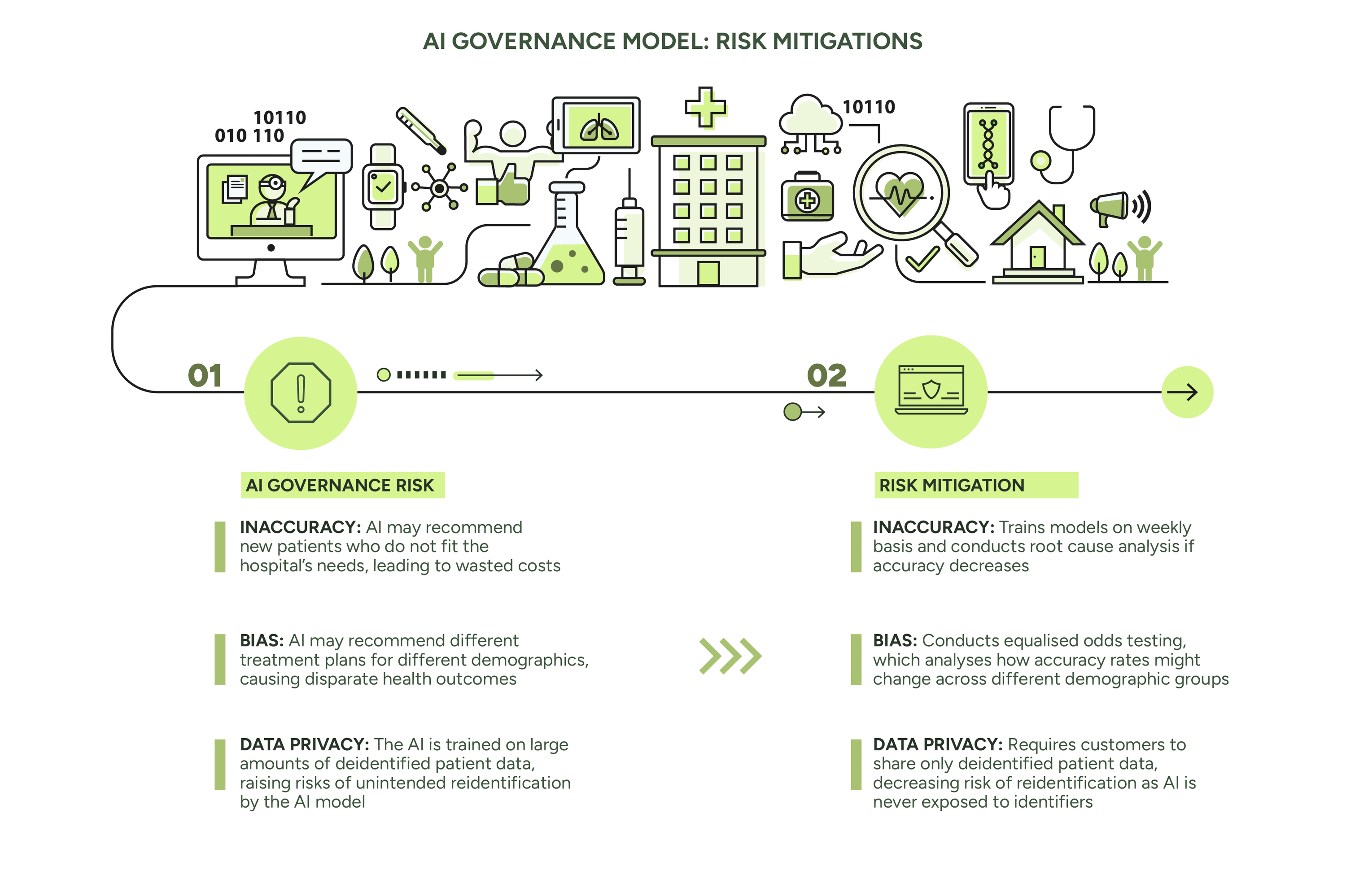
Case study: Implementing control systems for inaccuracy, bias and data privacy in the healthcare industry.
In one of our recent webinars [7], Emily Goldstein-McGowan from Malk
Partners and Stephen Rockwell from HSAI have shared the lessons learned from several projects on the ESG implications for responsible AI use.
The team supported a patient acquisition company for the healthcare industry, implementing control systems for inaccuracy, bias and data privacy
sensitive topics in an industry that has to navigate high tension between
opportunity for AI insights and the need for strict privacy controls.
Our client’s use of AI was twofold: matching potential new patients and the ideal pharmaceutical or hospital service, whilst also analysing patient activity & attrition to improve their experience.
In our work, we identified the risks with the AI governance model and recommended actions to ensure optimal risk mitigation.
This case is not isolated and can be cascaded across industries. AI governance and strict controls are essential to prevent privacy
breaches and regulatory violations. Comprehensive oversight is non-negotiable, despite pressure to accelerate innovation.
03. Conduct a cost-benefit analysis
When evaluating whether to adopt AI, the conversation often centres
on productivity, efficiency and occasionally, environmental reporting.
But a truly sustainable cost-benefit analysis goes further to better understand the mid- to long-term costs of AI. According to the 2025 Gartner CEO and Senior Business Executive Survey, over 50% of CEO’s “are fair (at best) at preventing or mitigating risks associated with AI implementation.”
Decision makers should ensure that the business case or why using a new AI product outweighs the environmental, social and economic impacts for society and their business.
Environmental impacts:
AI models consume significant energy, contributing to greenhouse gas emissions
and water usage. According to the World Economic Forum, “training a single large [AI] model can require millions of litres of [water].”
Our colleague Emily Owen, Associate Hydrologist, recently explored the impact of data centres’ water usage [8] on our natural water capital, highlighting our collective responsibility in delivering water neutrality.
Research from Goldman Sachs [9] estimates that using 2023 as a baseline, “global power demand from data centres will increase 50% by 2027 and by as much as 165% by the end of the decade.” And according to the International Energy Agency (IEA), 30% of global electricity used to supply data centres still comes from coal, followed by renewables (27%), natural gas (26%) and nuclear (15%).
While strides in wind and solar deployment will scale to meet the growth in data centre electricity demand, the IEA projects [10] that “new demand from data centres is a significant near-term driver of growth for natural gas-fired and coal-fired generation.”
Based on mineral use projections by the IEA, it is estimated that data centre growth will annually require an estimated “512,000 tonnes of copper and 75,000 tonnes of silicon”. The heavy use of these finite materials poses risks [10] for ecosystems, supply
chains and community wellbeing.
Social impacts:
Cobalt mining is part of the AI hardware supply chain (laptops, GPUs, data-centre power systems). Litigation filed at the beginning of 2019 against the likes of Apple, Tesla and Google on allegations of child labour in the Democratic Republic of Congo, where over 60% of the world’s cobalt supply comes from, highlights legal and reputational exposure from the perspective of a company’s supply chain due diligence.
Further along the supply chain, the working conditions of content moderators and data annotators whose labour is essential for training models are coming under increasing scrutiny.
For example, OpenAI was accused of paying Kenyan workers less than $2
per hour to view and moderate harmful content. Beyond the above-outlined social risks linked to data annotation, content moderation, and mineral extraction, responsible deployment of AI requires ensuring fairness, transparency, and human oversight. High-risk use cases can amplify bias, exclusion, or inequality if not managed carefully.
Heightened regulatory scrutiny and emerging financial penalties make it essential for companies to incorporate these social risks into their overall cost-benefit analysis ahead of adopting or expanding AI solutions.
Further financial risks:
These environmental and social impacts can have concrete financial consequences for businesses. While companies continue to face pressure from investors and regulators to reduce emissions and report climate impacts, this pressure is multiplied by AI adoption or expansion. There is another component that is essential in the cost-benefit analysis ahead of adopting or expanding AI use: multiple reports based on investor disclosures show strong revenue growth but very large losses and cash burn of the leading AI provider OpenAI. This
indicates industry-wide profitability challenges linked to compute, energy, and partnership economics.
Energy and industry sources forecast surging power demand and higher electricity prices, coupled with hardware constraints [11] and investor concerns on the return on AI spending following Big Tech’s massive AI CapEx costs [12].
This supports the view that, even under conservative assumptions, computer needs (and therefore costs) for AI models are expected to grow dramatically over the next five to eight years, at least. TIME’s analysis published in 2024 (based on Stanford & Epoch AI research) confirmed that the cost to train top models has doubled to tripled annually since 2016, and hardware costs alone are doubling every nine months [13].
Companies must ensure their cost-benefit analyses account for realistic pricing in light of this trend.
As companies move from prototypes to scaled deployments that drive sharp increases in cloud and compute costs, there is an acute risk that many adopters of AI solutions are underestimating the potential financial consequences of these investments.
Beyond this, companies’ cost-benefit analyses should account for future compliance costs, penalties, and forced operational changes if social and environmental considerations are not adequately addressed from the start.
However, starting small minimises both environmental impact and compliance risk, allowing you to scale responsibly once you understand the full footprint of your deployment. The following are critical points to include in your cost–benefit analysis:
- Financial ROI compared to manual processes
- Energy consumption and projected emissions
- Impact on employees and workflows
- Compliance costs and governance requirements
- Potential risks to brand reputation or trust
04. Ready to scale AI? Futureproof your infrastructure
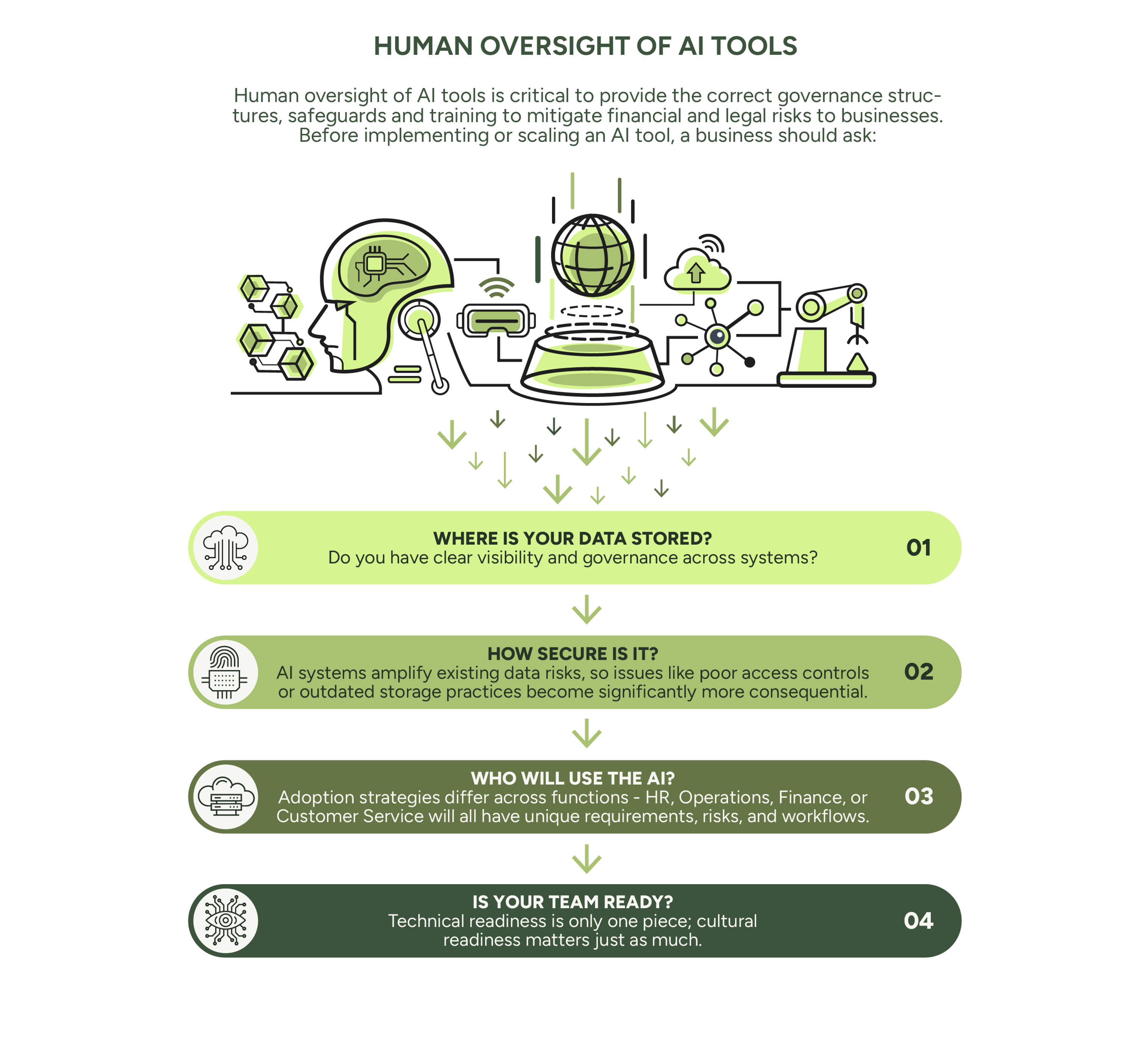
Now that you know your “why”, your legal and other risks and the likely business benefits, it’s time to plan, specifically to understand the current state of your organisation’s data and digital infrastructure. Many AI initiatives fail not because the models don’t work, but because the underlying data is incomplete, inconsistent, or insecure.
Modern workplaces often run their day-to-day operations across a plethora of data platforms and systems simultaneously.
If these systems are not correctly safeguarded or synced, user prompts could lead a new AI tool or platform to access inappropriate data (the HR database, for example) or provide incorrect answers by combining data snippets from various sources.
Risks are further exacerbated by user errors. 43% of AI users surveyed in the “Oh Behave! The Annual Cybersecurity Attitudes and Behaviours Report 2025-2026” [14] said they “share sensitive workplace information with AI tools without their employers’ knowledge, including internal company documents (50%), financial data (42%), and client data (44%)”.
This can be very costly for a company as it makes you vulnerable to data leaks
and regulatory violations, and racks up costs with the AI platform itself. Each change to finetune the AI tool after implementation will incur additional costs for the business.
Without clarity on these foundations, jumping into AI can create more challenges than benefits. But it doesn’t need to be an overwhelming task reserved for a handful of specialists.
With support from in-house expertise and the right external partners, you can build a thoughtful, future-ready approach that aligns with your goals and values.
Every day, the SLR teams link AI and digital capability to real-world science and delivery, as our solutions are grounded in decades of proprietary technical work across ecosystems, industries, and geographies, ensuring that innovation stays connected to the physical realities of your operations.
In upcoming resources, we will continue to share practical guidance to support the design and implementation of your AI roadmap.
Advisory Digest
Enjoyed this article? For more like it, get SLR's quarterly sustainable business briefing straight to your inbox.
Sign up
References
1. www.bbc.co.uk
2. www.orgvue.com
3. www.capitalmarkets.bmo.com
4. www.artificialintelligenceact.eu
5. www.artificialintelligenceact.eu
6. www.bbc.co.uk/news
7. www.malk.com
8. www.slrconsulting.com/insights
9. www.marcus.com/us
10. www.iea.org/reports
11. www.digitaldigest.com/gpu
12. www.finance.yahoo.com
13. www.time.com
14. www.staysafeonline.org
Recent posts
-
-

Data centre backup power may be temporary, but its air quality impacts aren’t
by Ben Turner
View post -