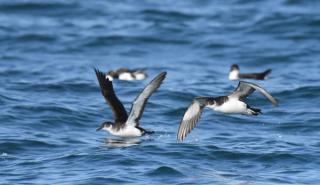
SLR supports University of Oxford research into offshore wind interactions with Manx shearwaters
Read more
As offshore wind development expands into new areas west of Scotland, across the Irish and Celtic Seas, and off the west coast of Ireland, understanding how seabirds use these waters is becoming increasingly important for environmental assessment and project consenting.
To help address this challenge, SLR’s Professor Bob Furness has partnered with Professor Tim Guilford of the University of Oxford to support a new doctoral research programme investigating the environmental factors that influence the foraging behaviour and distribution of Manx shearwaters (Puffinus puffinus). Through funding support and scientific supervision, SLR is helping to advance research that could reduce uncertainty in future offshore wind assessments and strengthen the evidence available to regulators and developers.
Manx shearwaters are becoming an increasingly important consideration for offshore wind developments in western UK waters. While the species has historically been of limited relevance to many projects, future developments are expected to be located in areas used more extensively by these birds. Improved understanding of their movements and behaviour will help strengthen the evidence base available to regulators, developers and environmental practitioners.
“It will be exciting to learn about the diet of Manx shearwaters from the DNA analysis as we currently know rather less about the importance of particular food types for these seabirds than we do for species such as kittiwakes and gannets. Yet it is likely that diet influences their distribution at sea and so affects vulnerability to impacts from offshore wind.”
Professor Bob Furness
The research is being undertaken by doctoral researcher and Clarendon Scholar Lena van den Hout at the Department of Biology, University of Oxford, and combines advanced GPS tracking with DNA metabarcoding techniques. By examining both where birds travel and what they eat, the project aims to identify the environmental factors that influence foraging behaviour and explain why feeding areas can vary between years and regions.
“Manx shearwater invest a large amount of time and effort into raising a single chick each year, while having to find all their prey out at sea. Throughout chick rearing, parents have to balance the need to provide for their chick while maintaining their own condition. Combining tracking, diving and diet data will be a very exciting opportunity to understand better what drives different foraging strategies.”
Lena van den Hout
“Manx shearwater breeding pairs share chick provisioning duties, with each partner mixing short foraging trips to catch food for the chick with much longer trips thought to be for re-building their own condition. But much is still unknown about this so-called “dual foraging” strategy, especially in terms of whether different prey types are required by parent and young. Lena’s project combines precision tracking with DNA metabarcoding, two state-of-the-art-technologies, to try to dig deeper into an unusual behaviour critical for understanding what controls this species’ movements and distributions in our seas.”
Professor Tim Guilford
This summer, Lena has been conducting fieldwork on Skomer Island, one of the world's most important Manx shearwater breeding colonies. Over the next three and a half years, the project will combine new field studies, laboratory analysis and existing tracking data from multiple colonies to build a more complete understanding of the species' feeding ecology.
SLR is contributing funding towards specialist DNA analyses and providing scientific supervision through Professor Furness. The research reflects SLR's commitment to supporting the science needed to enable sustainable offshore wind development and robust environmental decision-making.
By improving understanding of the factors that influence Manx shearwater distribution and behaviour, the project has the potential to reduce key uncertainties in offshore wind impact assessments and support evidence-based consenting as renewable energy development continues to expand.