Leveraging the energy transition for cost savings
- Post Date
- 12 May 2026
- Read Time
- 9 minutes

Industrial companies today are undergoing a steady rise in electricity
prices, a trend that has eroded operating margins. In parallel, the data shows that well-designed energy efficiency initiatives can directly translate into EBIT gains, equivalent to substantial new revenue. This tension raises a central question: Can organisations identify efficiency opportunities with a positive business case?
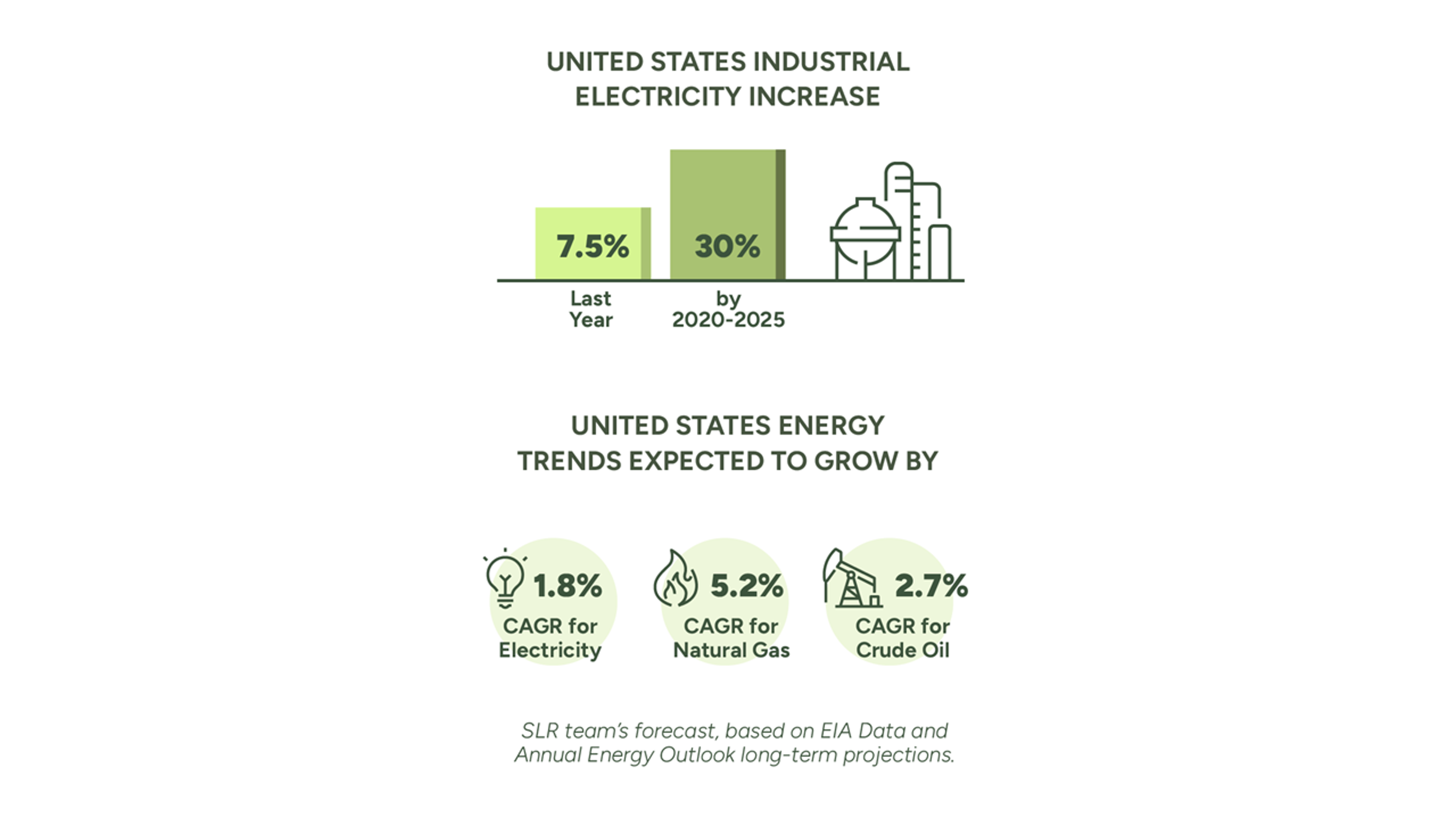
Energy efficiency has shifted from a technical afterthought to a boardlevel priority. Rising energy prices are pressuring operating budgets while increasing uncertainty for long term planning. In the United States over the latest five-year period, the cumulative increase in electricity prices reached 31.2% across all sectors [1] and 30.0% for industrial users.
Looking ahead, the U.S. Energy Information Administration EIA projects continued upward pressure. By 2050, energy prices are expected to grow at a CAGR of 1.80% for electricity, 5.20% for natural gas, and 2.70% for crude oil.
In this environment, organisations that treat energy efficiency as a strategic lever are better positioned to strengthen margins, shield operations from volatility, and reinvest savings into growth.
Efficiency has evolved into an enabler of broader transformations: modernisation of ageing infrastructure, improved reliability, and the capacity to support expansion without proportionate increases in energy consumption.
As the insights in later sections show, operational excellence in energy use is not just a sustainability win, it is a competitive advantage.
Energy efficiency:
“We’ve done it all”. Really?
Despite rising energy costs, research shows that many industrial facilities are still tapping only a fraction of their efficiency potential. Data from the Manufacturing Energy Consumption Survey shows that only 40% of manufacturers [2] participate in general energy management activities.
Yet, more than half acknowledge that energy is becoming a higher strategic priority. Most activity today remains concentrated in familiar areas such as LED lighting upgrades and HVAC (heating, ventilation, and air conditioning) improvements.
These activities collectively represent only 16% of industrial electrical consumption. The real opportunity lies in process-related usage, including process heating and cooling, and machine drives such as compressors. Fewer than 25% of manufacturing establishments apply energy-saving technologies or practices in these areas. This gap is precisely where the highest value improvements can be found.
These opportunities typically require no change to production processes, but they do require visibility, measurement, and structured energy management.
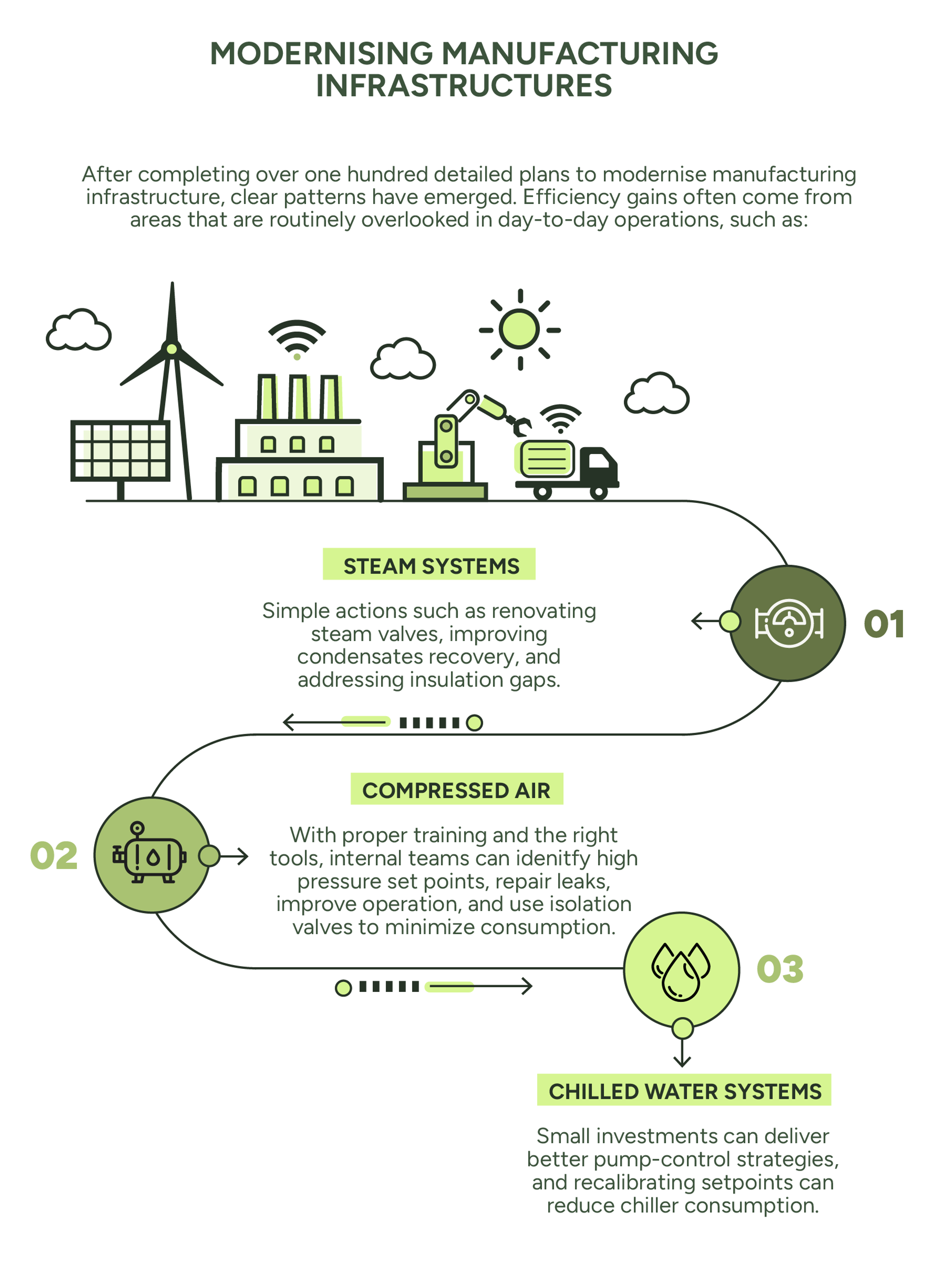
Our work across more than 2,000 industrial sites shows repeatedly that the most overlooked systems (i.e. steam networks, compressed air, chilled water loops) often hold the greatest potential for short payback, high-impact savings.
Next, digital controls and improved measurement capabilities are unlocking new forms of operational optimisation. These advancements bridge the gap between traditional efficiency projects and the modernised, automated infrastructure that
manufacturers are striving toward.
By broadening the scope beyond the usual suspects, organisations can redirect their energy strategies to the systems that matter most, building momentum for
the deeper opportunities.
Beyond these foundational measures, we also see other technically feasible, CAPEX-driven projects that offer attractive returns, especially in auxiliary systems not directly tied to core production processes. Examples include upgrading controls for dust extraction systems, implementing automatic shutdown of painting booths, and implementing boiler waste heat recovery.
Across our client operations and their sites around the world, these improvements and targeted capital investments routinely reduce energy consumption by 5–15%, while simultaneously strengthening reliability and unlocking capacity for future growth.
Going beyond equipment replacement: Smart controls for the next efficiency steps
Sites that have optimised their energy management should investigate control upgrade solutions that bring the next wave of energy efficiency. Upgrading control of elements in a system can bring significant savings with reduced CAPEX investment compared to the replacement of the asset. When selecting these solutions, it is crucial to find a reliable supplier that can improve the operation without creating a production risk. We have identified some clear cases that can be implemented at scale:
- Master controllers for air compressors can optimise the operation of multiple compressors, stabilise pressure, minimise unloaded run time, and support predictive maintenance. Atlas Copco [3] and Kaeser [4] have off-the-shelf platforms performing advanced operational strategies on existing compressors, bringing significant savings in energy consumption and maintaining security by keeping pressure stable.
- Plants with high HVAC consumption can migrate to advanced supervisory controls and find significant savings. Companies such as Johnson Controls [5] or Trane Technologies [6] propose Modelpredictive or MLbased optimisation to continuously tune chiller staging, pump speeds, and tower setpoints, optimising the system performance instead of setting specific controls for each element.
Unlocking value through incentives and strategic capital investment
The right financial tools will help the business accelerate the implementation
of those capital-driven projects. One of the most effective ways for industrial sites to ramp up on energy efficiency is to leverage a stacked incentive strategy that significantly improves project returns.
As an example, it might include a rebate from the local utility for the engineering study, a state funding programme for the savings achieved (in $/therm or $/kWh), and a “cashback” for the investment in the first year with an accelerated depreciation.
A question now arises: Does your Chief Financial Officer know about these three incentive channels? If not, it’s time for a conversation on:
1. Accelerated Depreciation: Under the “One Big Beautiful Bill Act”, for example, projects with a five-year payback can apply accelerated depreciation in the first year.
Depending on state tax structures, this mechanism can generate a positive year one cashflow of 21–30% of the initial CAPEX, transforming projects that once seemed marginal into clear financial wins.
In Mexico, a similar instrument is available under the “Plan Mexico” strategy, and in Canada under the “Canada Accelerated Investment Initiative”.
2. Utility Programmes: Beyond federal or state tax incentives, local utilities play an important role. We have supported clients to connect with utility programmes in Canada and in the US, obtaining a rebate on the project case or a payment for the energy management services.
Energy efficiency programmes vary by service territory, making it essential for each site to engage directly with its power provider. Utilities often support both standard and custom project pathways, with custom programmes offering rebates tied to verified savings, typically expressed as $/ kWh or $/therm reductions.
3. State Level Incentives: At the state level, decarbonisation programmes offer an additional layer of support, ranging from funding feasibility studies to providing partial financing for implementation.
Because these programmes evolve frequently, and many operate on limited time or first come first served funding windows, organisations that maintain a structured site level plan are best positioned to capitalise on them.
Across all three incentive channels, our key learning is clear: a proactive, well-coordinated strategy dramatically enhances the business case for energy efficiency investments, making it possible to unlock CAPEX, accelerate payback, and maximise both economic and sustainability outcomes.
Framing the business case for energy efficiency
Even when the opportunities are clear, leaders often ask us a fundamental question: “Is it worth the effort?”
The answer becomes compelling when energy savings are reframed in terms that resonate with financial decision makers.
In sectors with thin margins, such as automotive manufacturing, small reductions in energy spend translate into substantial revenue equivalence.
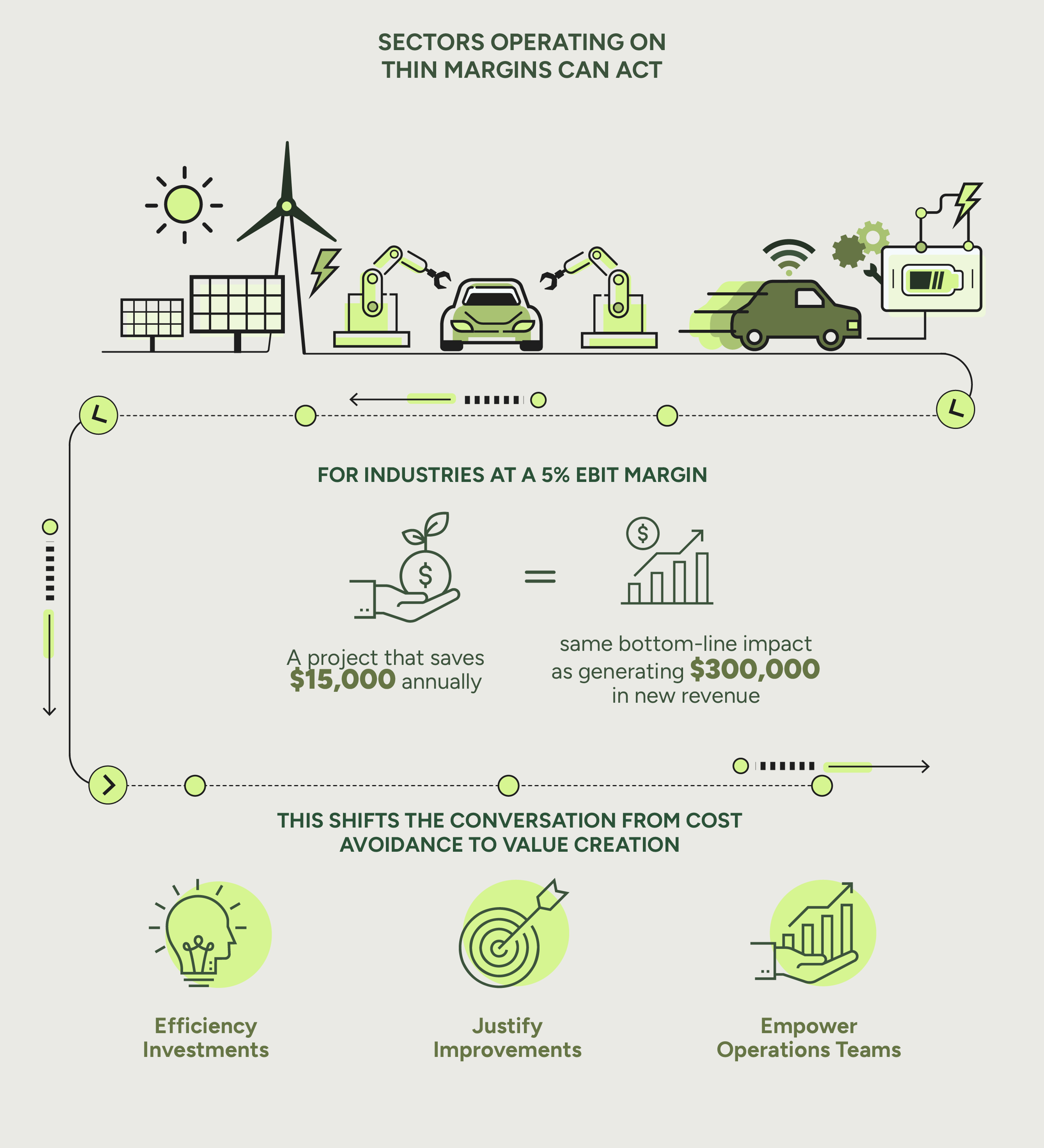
For example, in an industry operating at a 5% EBIT margin, a project that saves $15,000 annually has the same bottom-line impact as generating $300,000 in new revenue.
This framing shifts the conversation from “cost avoidance” to value creation, empowering operations teams to justify efficiency investments. Beyond individual projects, many organisations benefit from establishing an internal energy savings reinvestment account.
This mechanism reserves realised savings to fund future efficiency projects. When paired with the incentives and strategic capital approaches described above, this creates a self-sustaining engine for modernising infrastructure and accelerating decarbonisation.
In every project, we work with clients to remind their leadership that the business case for energy efficiency is not just about reducing spend, it’s about strengthening competitiveness. Companies that proactively manage energy risk can protect margins, free up capital, and build operational resilience in a volatile energy landscape.
Advisory Digest
Enjoyed this article? For more like it, get SLR's quarterly sustainable business briefing straight to your inbox.
Sign up
References
- https://www.eia.gov/
- https://www.eia.gov/consumption/manufacturing/
- https://www.atlascopco.com/en-us/compressors/service-parts-maintenance-landing/controllers-and-connectivity
- https://www.kaeser.com/int-en/products/controller/compressed-air-management-system
- https://me.johnsoncontrols.com/services-and-support/optimization-and-retrofit-solutions/central-chiller-plant-optimization
- https://www.trane.com/commercial/north-america/us/en/products-systems/smart-building-technology/building-controls-solutions/tracer-sc-plus/chiller-plant-control.html
Recent posts
-
-

-

The economics of mine closure and what comes next
by Dr. Chris Meikle, Jeremy Collyard, Elysśa De Carli
View post