Beyond ESG: Mining and the re-materialising world
- Post Date
- 28 September 2026
- Read Time
- 13 minutes
Minerals are returning to the centre of industrial policy, energy security, and geopolitical strategy. For mining, the next sustainability challenge is not whether standards matter, but how to integrate them with the timing, coordination, and legitimacy needed to deliver complex projects.
For much of the past two decades, mainstream economic narratives in advanced economies have often privileged finance, digital platforms, services, and asset-light business models. The physical systems beneath them (energy, minerals, infrastructure, and manufacturing) never disappeared; they simply became less visible. That is changing.
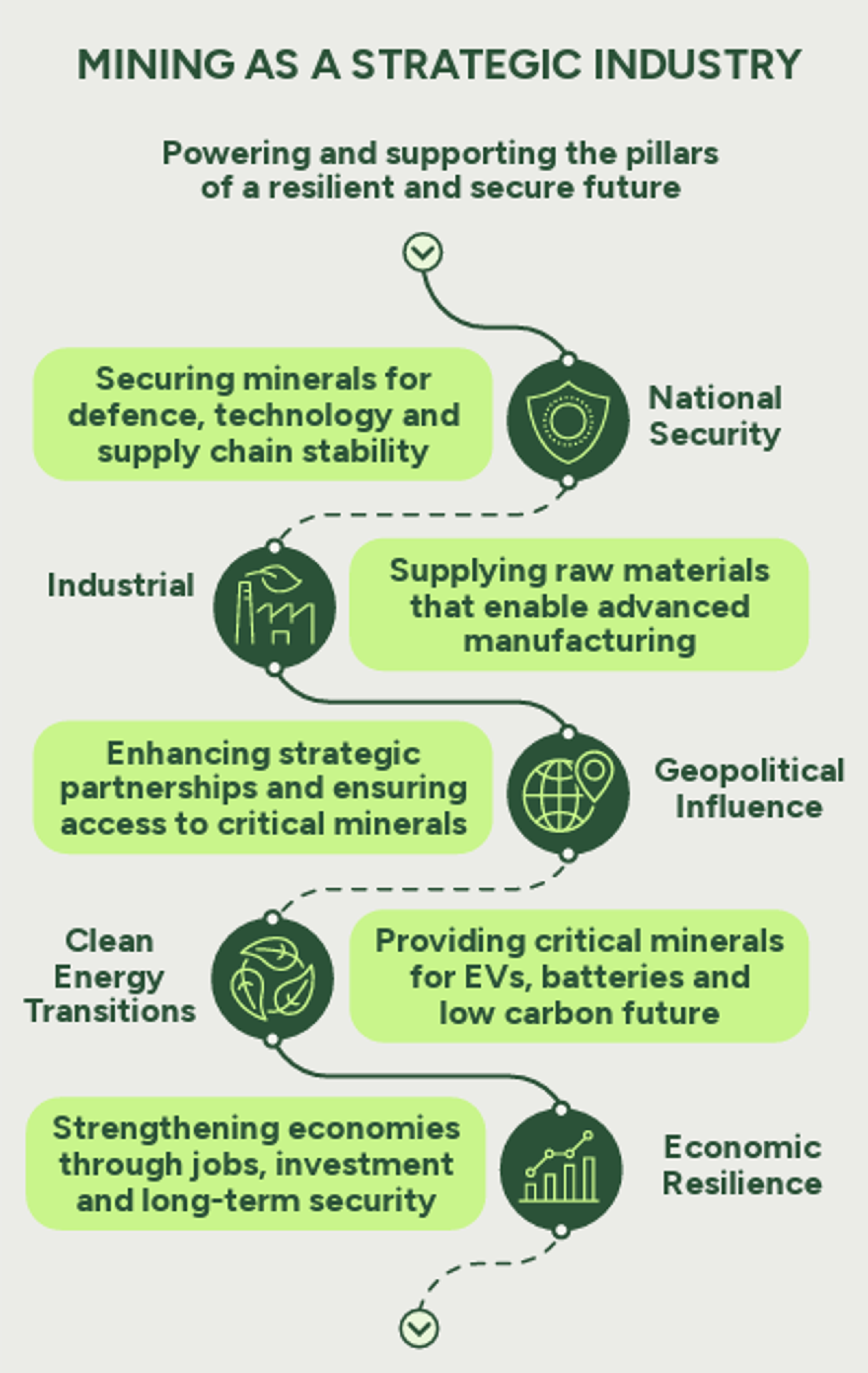
Energy security, industrial policy, strategic supply chains, defence, advanced manufacturing and mineral processing have returned to the centre of policy and investment debate. Mining is consequently being viewed not only as an extractive industry, but as part of the architecture of economic resilience and geopolitical capacity.
This shift changes the sustainability question. This article is not an argument against environmental, social and governance (ESG) approaches, nor against high environmental and social standards. It asks a narrower and more useful question: has ESG become too broad a shorthand to guide the design and governance of strategic mining systems?
ESG helped place critical risks and impacts on the agenda. But it was not designed to carry the full burden of integrating geology, infrastructure, permitting, community relationships, finance and strategic time across a mine's lifecycle. Mining now needs a sustainability logic that can connect these elements rather than manage them as parallel workstreams.
The material economy changes the question
The return of the material economy does not mean the world has become less digital. It means the physical foundations of digital, industrial, and geopolitical power have become harder to ignore.
Electrification, data infrastructure, defence systems, industrial renewal and the energy transition all depend on minerals, processing capacity, power, transport and functioning institutions.
Mining makes these dependencies unusually visible. Few sectors expose so clearly the relationship between material capacity, territorial legitimacy, technical sequence and time. A mineral resource has strategic value only when a society can assess it, authorise it, finance it, build the supporting infrastructure, and operate it responsibly.
Time, therefore, matters in more than financial terms. Delays affect capital allocation, project economics and expected returns, but they can also affect industrial readiness, supply-chain exposure, infrastructure planning and a country's ability to convert mineral endowment into usable capacity.
S&P Global Market Intelligence's 2026 update found an average of 16 years from discovery to production across 232 assets. For non-operating projects that had reached feasibility, the estimated average approached 30 years. [1]
The objective is not speed for its own sake. It is coherent sequencing and timely, durable decisions. A process that moves quickly but weakens environmental performance or public legitimacy is not sustainable. Nor is a process that becomes progressively denser while failing to produce clearer decisions, better design or more trusted outcomes.
What ESG made visible - and what it left unresolved
Any attempt to rethink sustainability in mining should begin by recognising what ESG has achieved. A mine operates within water systems, ecosystems, labour markets, transport networks, local communities, Indigenous territories, permitting regimes and national development narratives. Its risks are geological and metallurgical, but also environmental, social, regulatory, political and reputational.
ESG gave these issues a language that could travel across boardrooms, capital markets and policy circles. It helped decision-makers recognise that environmental and social performance can affect access to capital, permits, political support, workforce stability and long-term operating continuity. It also challenged the idea that legitimacy could be added as a communications layer after the technical design was complete.
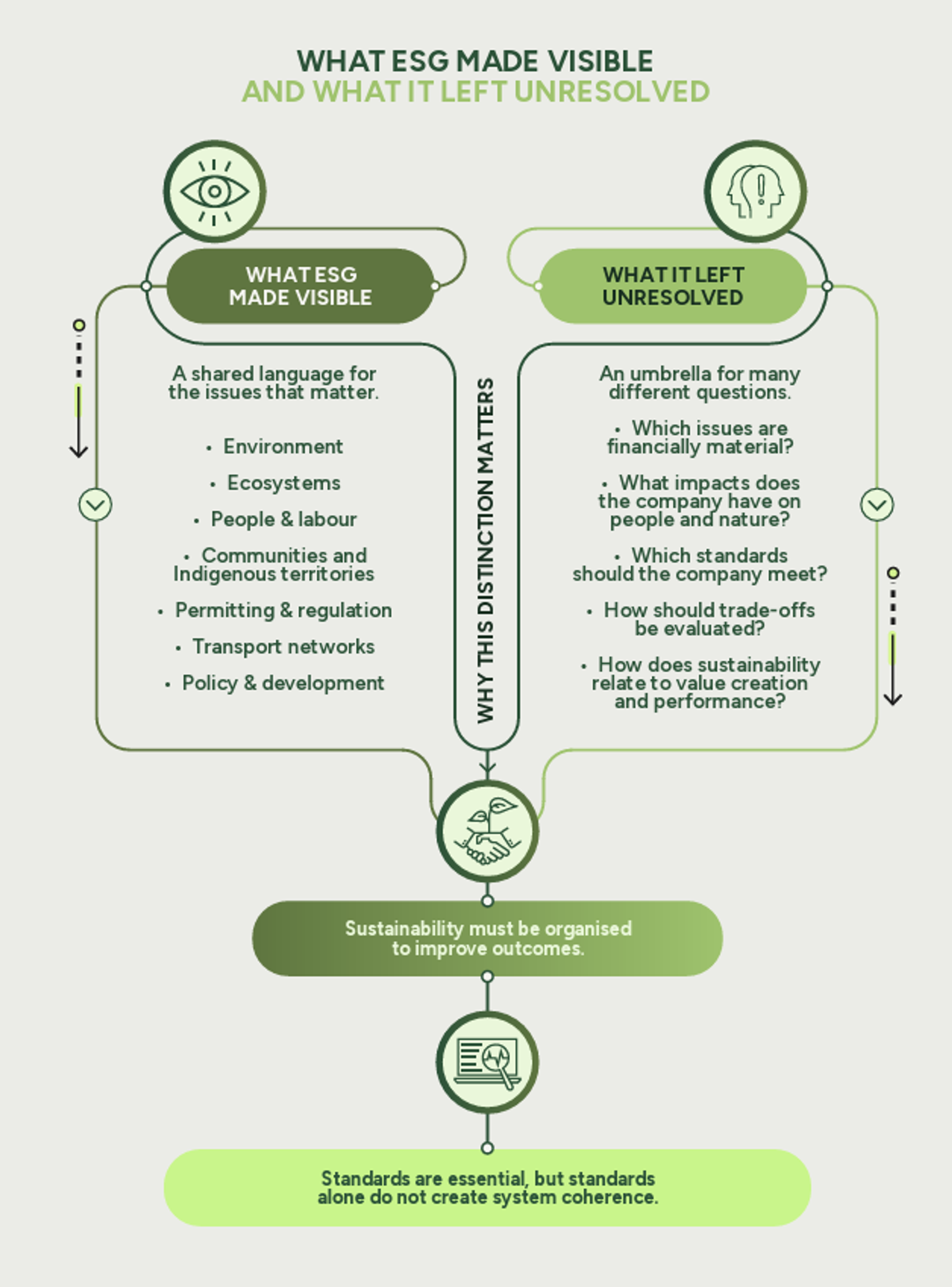
That correction was necessary. Yet making an issue visible is not the same as resolving how it should be governed. Over time, ESG became an umbrella for several different questions: which sustainability issues are financially material; what impacts a company has on people and nature; which standards it should meet; how trade-offs should be evaluated; and how sustainability relates to value creation and operating performance.
The problem is not that ESG failed at a task it was designed to perform. It is that the label has been asked to do too many jobs at once. In some settings, it remains useful shorthand. In others, its breadth makes it difficult to prioritise, integrate and act.
For mining, this distinction is especially important. The debate is no longer simply whether environmental, social and governance factors matter. That point has largely been won. The harder question is whether sustainability is being organised in a way that improves project design, strengthens legitimacy, clarifies trade-offs and sustains delivery over long time horizons. Standards are essential, but standards alone do not create system coherence.
From parallel process to operating logic
Mining is capital-intensive, placebased, politically exposed and deeply sequential. Geology, metallurgy, water, power, infrastructure, environmental assessment, Indigenous rights and engagement, community relationships, permitting, financing and market strategy do not unfold as separate worlds. They interact continuously.
A change in one part of the system can alter the value or feasibility of the others. A water constraint can reshape engineering and capital requirements. An infrastructure decision can change the project's footprint and community impacts. A permitting delay can affect financing, procurement and market timing. Fragmentation therefore has compounding consequences.
When sustainability is treated as a parallel agenda, organisations can accumulate process without achieving equivalent gains in clarity or performance. Reporting expands, consultation multiplies, review structures deepen, and documentation becomes more detailed, while the overall system may still struggle to produce technically coherent, financeable and socially legitimate decisions.
This is not an argument for weaker scrutiny. It is an argument for sharper scrutiny: review that tests alternatives, improves design, makes trade-offs explicit and produces decisions that can endure. Sustainability must operate inside the project's decision architecture, from early option selection through construction, operations, closure and post-closure transition.
The practical test is straightforward. Does the sustainability process produce better choices, more credible commitments, clearer accountability and more resilient outcomes? Or does it mainly produce additional layers of validation after the material decisions have already been made?
Beyond ESG: a field, not a single successor
There is no settled post-ESG consensus. Instead, several approaches are refining different parts of the sustainability landscape.
- Investor-focused disclosure. The ISSB and IFRS Sustainability Disclosure Standards establish a global baseline for information on sustainability-related risks and opportunities that is relevant to investors and other providers of capital. Their centre of gravity is financial materiality, governance and decision-useful disclosure. [2,3,4]
- Double materiality. The European sustainability reporting approach asks companies to consider both how sustainability issues affect the organisation and how the organisation affects people and the environment. It broadens the accountability frame beyond investor relevance alone [5,6]
- Integrated reporting and thinking. These approaches resist the separation of financial and nonfinancial performance. They connect strategy, governance, resources, relationships and performance to the creation, preservation or erosion of value over time. [7,8]
- Project-level and thematic standards. The IFC Performance Standards and Equator Principles bring environmental and social risk into project design, due diligence and financing. [9,10] TNFD adds recommendations for nature-related risk management and disclosure, while SBTi provides standards and guidance for setting science-based emissions targets. [11,12] These tools are essential, but each addresses only part of the wider system. [13,14]
- Rational Sustainability. Alex Edmans' concept of Rational Sustainability offers a different contribution. It argues for evidence, long-term value, explicit trade-offs, diminishing returns and real outcomes rather than labels or box-ticking. [15] This travels well to mining because it rejects the false choice between sustainability and performance. However, mining also requires a system-level view of interdependence across institutions, disciplines, territory and time.
A working concept for mining: Systemic Rational Sustainability
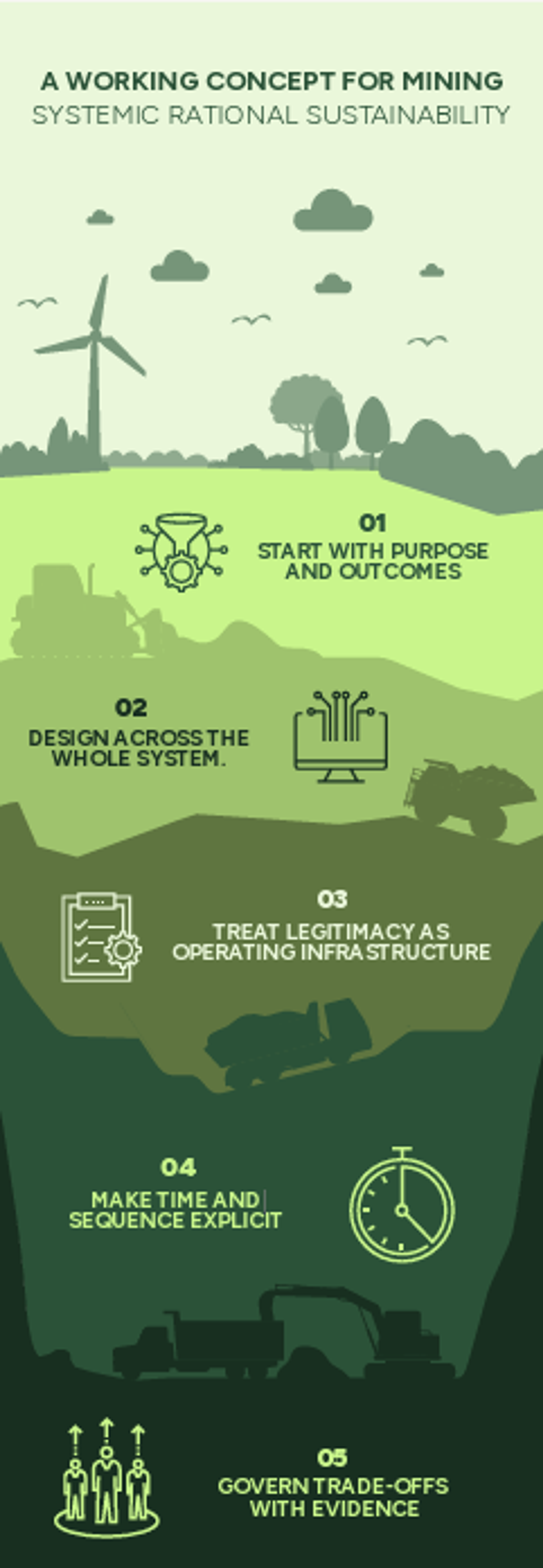
Systemic recognises lifecycle interdependencies. Rational requires evidence, disciplined judgement and transparent trade-offs. Sustainability brings environmental integrity, social legitimacy, economic viability and strategic resilience into one decision frame.
- Start with purpose and outcomes. Define the long-term value the project is intended to create, the public and private outcomes it must support, and the material risks and impacts that could undermine them. Avoid using a label as a substitute for a theory of value or a clear decision objective.
- Design across the whole system. Bring environmental, social, technical, infrastructure, commercial and closure considerations into option selection early. Organise teams around shared decisions and system interfaces, not only disciplinary deliverables. The aim is to identify constraints and trade-offs before they harden into cost, delay or conflict.
- Treat legitimacy as operating infrastructure. Legitimacy is not a public-relations outcome. It is built through respect for rights, credible institutions, meaningful engagement, transparent reasoning and the fair treatment of benefits and burdens. Like physical infrastructure, it requires early investment, maintenance and adaptation over time.
- Make time and sequence explicit. Map dependencies, decision rights and critical paths across permitting, engineering, engagement, infrastructure and finance. Time should never be used to justify weaker standards, but neither should it be treated as an externality. Poor sequencing can erode value, trust and strategic capacity even when every individual process appears compliant.
- Govern trade-offs with evidence. Mining decisions rarely maximise every objective at once. Compare alternatives, document assumptions, acknowledge uncertainty and test whether additional process is likely to produce material improvement. The objective is not to eliminate judgement, but to make it more rigorous, transparent and accountable.
What this means in practice
For project owners, Systemic Rational Sustainability means integrating sustainability into project definition, stage-gate decisions and the critical path rather than assigning it to a separate assurance stream.
For governments and regulators, it means aligning mineral ambitions with the institutional capacity, infrastructure planning and coordinated review needed to make high standards executable. Coordination should improve the quality and durability of decisions, not weaken independent oversight.
For investors and lenders, it means looking beyond the existence of policies and disclosures to the capability of a project team to manage interfaces, honour commitments, and convert risks into design choices, schedules and capital plans.
For advisors, it means maintaining a line of sight from environmental and social commitments to engineering, economics, governance and operating performance across the whole lifecycle.
Moving beyond ESG does not mean moving beyond environmental, social or governance performance. It means moving beyond a label that has become too elastic to organise the full complexity of strategic mineral systems.
At SLR, this is consistent with how we approach mining across its lifecycle: bringing environmental, social, technical and economic perspectives into the same decision architecture to support long-term viability.
Applying the concept of systemic rational sustainability enables mining leaders and their value chain to measure sustainability not by the volume of process, but by the quality of decisions and the durability of outcomes.
Advisory Digest
Enjoyed this article? For more like it, get SLR's quarterly sustainable business briefing straight to your inbox.
Sign Up
References
- S&P Global Market Intelligence, Mine Permitting Delays Discovery-to-Production Timeline - https://www.spglobal.com/market-intelligence/en/news-insights/research/2026/07/mine-permitting-delays-discovery-to-production-timeline
- IFRS Foundation, Introduction to the ISSB and IFRS Sustainability Disclosure Standards - https://www.ifrs.org/sustainability/knowledge-hub/introduction-to-issb-and-ifrs-sustainability-disclosure-standards/
- IFRS Foundation, IFRS S1: General Requirements for Disclosure of Sustainability-related Financial Information - https://www.ifrs.org/issued-standards/ifrs-sustainability-standards-navigator/ifrs-s1-general-requirements/
- IFRS Foundation, IFRS S2: Climate-related Disclosures - https://www.ifrs.org/issued-standards/ifrs-sustainability-standards-navigator/ifrs-s2-climate-related-disclosures/
- European Commission, Corporate Sustainability Reporting - https://finance.ec.europa.eu/financial-markets/company-reporting-and-auditing/company-reporting/corporate-sustainability-reporting_en
- European Commission, Double Materiality - https://ec.europa.eu/newsroom/fisma/items/754701/en
- IFRS Foundation, Integrated Reporting - https://www.ifrs.org/issued-standards/integrated-reporting/
- IFRS Foundation, International Integrated Reporting Framework - https://www.ifrs.org/issued-standards/integrated-reporting/framework/
- IFC, Sustainability Framework and Performance Standards - https://www.ifc.org/en/what-we-do/sector-expertise/sustainability/policies-and-standards
- Equator Principles Association - https://equator-principles.com/about-the-equator-principles/
- Taskforce on Nature-related Financial Disclosures (TNFD) - https://tnfd.global/
- TNFD Recommendations - https://tnfd.global/recommendations/
- Science Based Targets initiative (SBTi) - https://sciencebasedtargets.org/
- SBTi Standards and Guidance - https://sciencebasedtargets.org/standards-and-guidance
- Alex Edmans, Rational Sustainability Link - https://papers.ssrn.com/sol3/papers.cfm?abstract_id=4701143
Recent posts
-
-

The economics of mine closure and what comes next
by Dr. Chris Meikle, Jeremy Collyard, Elysśa De Carli
View post -