
Dye study and mixing zone assessment
- Client Name
- Marine Harvest
- Location
- Port Hardy, British Columbia, Canada
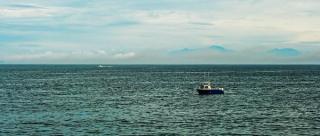
SLR conducted a detailed mixing zone and dye study for a seafood processing facility on Vancouver Island, assessing the dispersion and dilution of treated effluent discharged into a marine environment. The study provided regulatory confidence that the outfall discharge met water quality objectives and did not adversely impact the receiving environment.
Challenge
The client required a scientifically defensible assessment of effluent dispersion from their deep-water outfall to demonstrate compliance with provincial and federal environmental standards. Regulatory agencies needed assurance that effluent from the seafood processing operation, particularly the biochemical oxygen demand (BOD) load, would not negatively affect dissolved oxygen levels or overall water quality in the receiving bay. The client’s goal was to quantify mixing behavior under real tidal conditions and confirm that their discharge was protective of the marine environment.
Solution
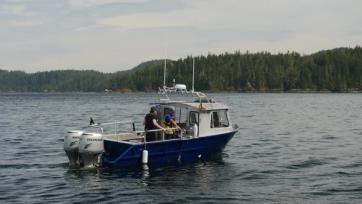
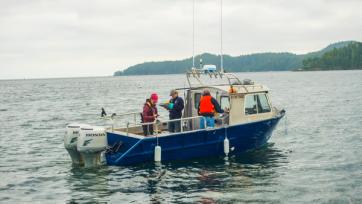
SLR developed and implemented a comprehensive work plan and health and safety plan to execute an in-situ dye tracer study at the facility’s marine outfall, located more than 100 feet below the surface. Using Rhodamine dye as a tracer, our field team monitored dye concentrations over several tidal cycles with specialized instrumentation towed behind a survey vessel. The observed dilution data were then used to calibrate a CORMIX hydrodynamic model to simulate effluent dispersion under varying conditions. This integrated field-and-modeling approach provided a robust understanding of mixing dynamics and allowed SLR to evaluate potential effects of BOD loading on dissolved oxygen in the bay.
SLR was selected for this project due to our recognized expertise in mixing zone studies, hydrodynamic modeling, and marine water quality assessments across the greater Pacific Northwest. Our team has extensive experience supporting seafood processors throughout Oregon, Washington, British Columbia, and Alaska, bringing region-specific knowledge of regulatory requirements, coastal oceanography, and seafood industry operations.
Impact
The study confirmed that strong tidal mixing and dispersion at the outfall location effectively dilute the facility’s effluent, ensuring that water quality objectives for dissolved oxygen and other key parameters are maintained. The results demonstrated that the discharge does not have a measurable impact on the bay’s overall water quality, supporting continued operation of the facility within environmental compliance requirements.