Challenges to reach net zero data centres
- Post Date
- 04 December 2025
- Read Time
- 8 minutes

Artificial intelligence, cloud computing, and data-driven industries are fuelling an unprecedented boom in data centres globally, facilities that already consume an estimated 2–3% of global electricity and are poised to grow even faster. McKinsey estimates a 19-22% annual growth in demand for data centre capacity between 2023 and 2030 [1]. Yet this growth comes at a time when businesses, investors, and governments alike are under mounting pressure to deliver on net zero commitments, protect natural resources and communities, and build climate resilience.
How data centres are planned, powered, and operated will have global implications for decarbonisation, water security, and the reliability of our digital future. In the following insights, we have summarised a recent series of articles [2] on the practical solutions shaping the development of data centres worldwide. From alternative energy strategies to water-risk mitigation and holistic site planning, these perspectives demonstrate how sustainability can be embedded into data centre design, not as an afterthought, but as a driver of resilience, efficiency, and long-term value creation.
Embedding resilience, social value and sustainability from the outset
For years, AI/ICT has been proclaimed as an essential element of moving to a low-carbon economy. At the time, despite various organisations and individuals pointing out the ever-increasing energy requirements of data centres, these issues were effectively dismissed or put on the back burner. As the sector grows, so too will public expectations for transparency, benefit sharing, and responsible development.
Our work across sectors and geographies emphasises that data centres are indeed a critical infrastructure. Still, their social and environmental licence is not guaranteed. What's missing?
- Strategic feasibility early in the process: Integrating renewable energy access, storage capacity, and stakeholder engagement during initial planning avoids costly retrofits later and ensures resilience even as energy demand accelerates. In Tasmania, emerging projects are exploring the use of geothermal energy to power high-performance computing and AI-driven data centres [3]. Converting existing geothermal wells into power generators for energy-intensive facilities will enhance local energy resilience.
- Delivering broader community benefits: Circular economy principles, such as waste-heat reuse for district heating, offer both environmental and social dividends. European initiatives, such as France's Data4 campus, demonstrate how to align energy efficiency with local value creation [4].
Are energy systems transforming enough to enable grid-interactive data centres?
With AI computing requirements demanding up to 20 times more power than legacy systems, integrated energy solutions are critical for both resilience and decarbonisation.
There is a critical need to transform data centres into grid assets. Pairing energy storage with smart grid participation enables facilities to support renewable integration, balance supply and demand, and even earn revenue through ancillary services. In East London, we completed a Hyperscale Data Centre to enhance economic benefits to the London Borough of Newham, not least by harvesting the facility's significant heat output to provide a district heating scheme capable of heating thousands of residential properties.
Why water-smart design is critical for future-proofing projects
Another topic we were keen to write about is how companies have to consider water as a strategic constraint. Rising AI workloads amplify data centre cooling needs, increasing both direct water consumption and indirect impacts via energy production. Quantifying and valuing water risk is essential for sustainable operations.
Our advice is to plan sites around water risk and opportunity. In her article, our brilliant colleague Emily, a Chartered Water and Environmental Manager, argues that locating facilities near treated water sources or in areas needing flood mitigation, for example, can cut potable water demand while delivering co-benefits for communities and ecosystems.
What are the alternative energy pathways for net-zero alignment?
Moving beyond conventional backup power: Diesel generators and gas engines, while common, contribute to emissions and local air quality issues. Hydrogen fuel cells, redox flow batteries, and on-site renewables present emerging alternatives for cleaner, reliable power.
Balancing practicality and ambition: Technologies such as small modular reactors and geothermal energy show promise but face barriers, including capital costs, regulatory complexity, and geographic limitations. Concretely, we evaluated the suitability of LEED certification [5] for a client's proposed data centre development in New South Wales, Australia, with the goal of achieving a minimum Gold rating. The key challenge was that the local rating system lacked a data centre-specific pathway. The project's complex phasing and extended timeline posed difficulties in selecting the right certification approach. Through extensive collaboration and research, the path provided would achieve a Gold rating, while also offering a certification approach that accommodates the project's multi-phase delivery. It also established a replicable framework for applying LEED to our client's other data centre assets across Australia, providing added value beyond the original site evaluated.
Recommendations to take a holistic approach to site selection and feasibility
Assess every constraint upfront: Successful sites require early-stage, comprehensive reviews of grid capacity, water resources, permitting, air quality, land use, social impact and connectivity to minimise regulatory risk and development delays.
Integrate environmental considerations into early design: For example, managing impacts from backup power emissions, plant noise emissions, and biodiversity impacts at the outset accelerates approvals and supports long-term sustainability goals.
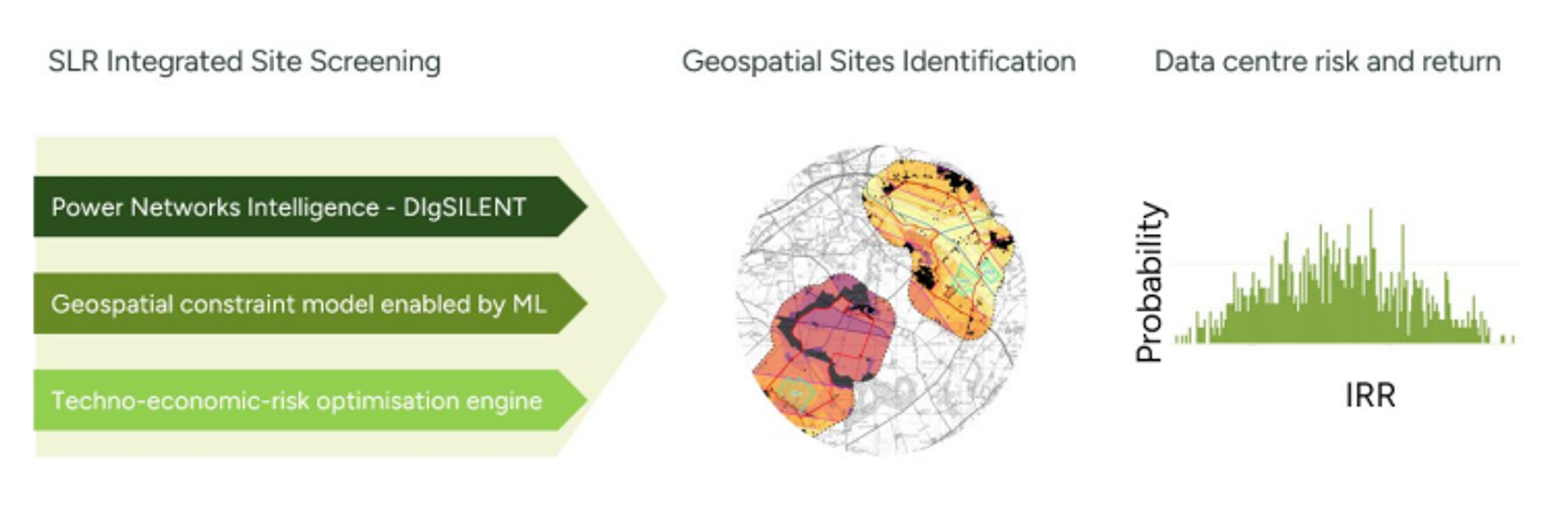
SLR has developed an innovative, integrated, and proprietary combination of site selection services, including grid capacity modelling using DIgSILENT Powerfactory, machine learning-enabled geospatial consentability modelling, and a techno-economic-risk optimisation engine enhanced by Monte Carlo simulation (as presented visually below). Through this service, we can identify viable data centre sites in a fast-track manner that is consistent with the actual grid capacity and the planning framework, and optimise the energy solution. We can also articulate the top three drivers of hyperscaler risk and return.
On the horizon: Evolve rapidly in a fast-growing market
As data centres continue to expand to meet the world's insatiable demand for digital services, the stakes for getting sustainability right will only grow. The technologies and strategies explored in this series show what's possible today. Still, the real question is: how quickly can the industry scale these solutions to deliver resilient, low-carbon, and water-smart infrastructure worldwide?
Every day, our global teams provide end-to-end support for clients in the data centre sector, ensuring a seamless transition from initial site selection to achieving Financial Investment Decision (FID). We are making this happen by a proactive, targeted approach to developers and owner/operators. We partner with them through a bundled service offering, underpinned by strong multi-disciplinary project management and deep technical expertise. Stay tuned for more, as we will be the main editors of a new book on hyperscalers and their impact on the new energy landscape.
In the following weeks, we'll be turning the spotlight on the United States. In this market, grid constraints, water scarcity, community concerns, and rapidly growing AI workloads are creating both challenges and opportunities for sustainable data centre development. As an example of the difficulties, at the end of 2024, approximately 2,300 gigawatts of generating assets are currently awaiting connection to the transmission network, resulting in substantial delays in project timelines. Watch this space as our teams will share more US-specific insights, and reach out to us if you would like to challenge us on any point of this evolving landscape.
Advisory Digest
Enjoyed this article? For more like it, get SLR's quarterly sustainable business briefing straight to your inbox.
Sign Up
---------------------------------------
References
Recent posts
-
-
Unlocking value through solar PV repowering: A focus on module replacement and DC/AC optimisation
by David Fernandez
View post -