
Driving down carbon in battery supply chains: Why it matters now
- Post Date
- 15 January 2026
- Read Time
- 3 minutes
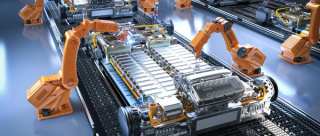
As the world accelerates toward electrification and renewable energy, batteries have become the backbone of the global energy transition. Yet, behind their green promise lies a hidden challenge: the carbon-intensive supply chains that produce them. SLR’s latest whitepaper, The Overlooked Criticality in Battery Supply Chains: Reducing Embodied GHG Emissions, explores why tackling these upstream emissions is essential and how manufacturers and OEMs can lead the charge.
The scale of the challenge
Battery demand is skyrocketing, with production expected to triple from 1 TWh in 2024 to 3 TWh by 2030. But the environmental cost is significant: the battery value chain accounts for an estimated 100–150 MtCO₂e annually. For electric vehicles, embedded battery emissions can represent up to 40% of total production emissions. Regulatory pressure is mounting too. EU Battery Regulation now mandates carbon footprint declarations, and OEMs face tightening Scope 3 targets. Reducing embodied emissions is no longer optional; it’s a strategic imperative.
Where emissions come from
Life-cycle assessments consistently show that 55–85% of a battery’s cradle-to-gate emissions occur before materials even reach the production plant. Graphite, nickel, aluminium, and copper dominate the emissions profile, with graphite alone contributing up to 49%. Most emissions arise during energy-intensive final processing stages, driven by electricity and heat use. In fact, electricity consumption accounts for roughly 60% of material-related emissions, making renewable energy adoption the single most impactful lever.
Key levers for decarbonisation
There are a variety of practical pathways to cut emissions across the battery supply chain:
- Renewable Electricity Transition: Corporate PPAs, energy certificates, and on-site generation can rapidly decarbonise electricity use.
- Heat Electrification: High-temperature heat pumps, electric boilers, and solar thermal systems offer viable alternatives to fossil fuels.
- Supplier Engagement: Mapping emissions hotspots and collaborating on low-carbon solutions unlocks systemic change.
- Innovation & Insetting: Co-investing in R&D for hard-to-abate processes and funding insetting projects ensures traceable, verifiable reductions.
Why act now
Early movers will gain more than compliance, they’ll secure access to low-carbon materials, strengthen supply resilience, and build competitive advantage as customer and regulatory scrutiny intensifies. Our whitepaper provides actionable recommendations for manufacturers and OEMs, from developing renewables programs for suppliers to leveraging multi-buyer PPAs and insetting mechanisms.
Ready to lead the transition?
Download the full whitepaper to explore detailed strategies, data-driven insights, and practical steps to decarbonise your battery supply chain. Together, we can make low-carbon batteries a reality and power a truly sustainable future.
Download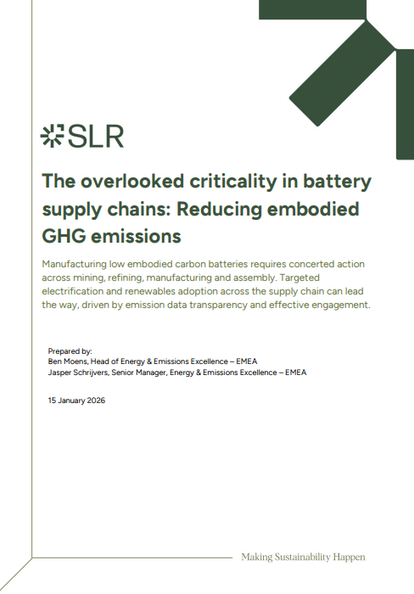
For more discussions on this matter, or to share your insights and feedback, get in touch with the authors of this article:
Ben Moens - ben.moens@slrconsulting.com and Jasper Schrijvers - jasper.schrijvers@slrconsulting.com.
Recent posts
-
-
Unlocking value through solar PV repowering: A focus on module replacement and DC/AC optimisation
by David Fernandez
View post -